
Major Backlash as Westerleigh Abattoir Seeks Massive Expansion
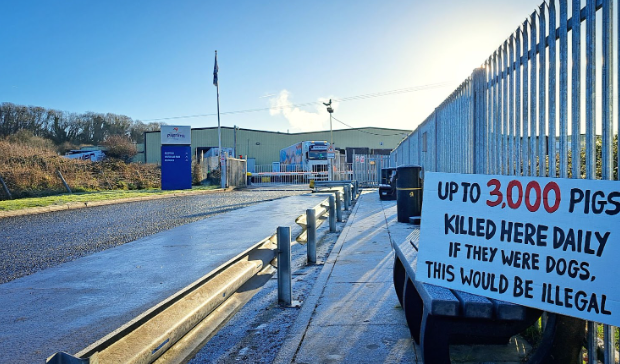
Outside of Westerleigh abattoir
Campaigners are urging South Gloucestershire Council to reject a planning application that would significantly expand Pilgrim’s UK’s Westerleigh abattoir, increasing slaughter capacity from 19,000 to 25,000 pigs per week, an additional 6,000 animals, bringing the total number of factory‑farmed pigs killed on site to 1.3 million per year [1].
Communities Against Factory Farming (CAFF) are supporting local residents to legally challenge this harmful development.
Pilgrim’s UK, part of a multinational conglomerate with more than £4.2bn in UK turnover and over 40 sites across the UK and Europe, exports pork products from Westerleigh to international markets including China, the US and Europe [2]. Local residents and campaigners argue that the expansion would place further strain on the surrounding community while doing little to improve UK food security.
Serious concerns have been raised about animal welfare at the site. The vast majority of pigs in England and Wales, around 90%, are stunned using high‑concentration carbon dioxide (CO₂), a method used at Westerleigh and recognised as causing significant suffering[3] [4]. The UK Government’s Animal Welfare Committee (AWC) has concluded that exposure to high levels of CO₂ causes pain, respiratory distress, fear and panic before loss of consciousness, and has recommended that CO₂ stunning be phased out within five years [5]. The UK Government’s Animal Welfare Strategy also signals a policy direction away from CO₂ use.
The proposed expansion also raises questions about the wellbeing of slaughterhouse workers. A growing body of peer‑reviewed research links slaughterhouse employment to elevated rates of depression, anxiety and violence‑supportive attitudes, with studies identifying associations between slaughterhouse work and antisocial behaviour, including sexual offending [6] [7]. Occupational health research further shows that slaughterhouse workers experience increased respiratory symptoms, declining lung function and chronic inflammatory responses correlated with length of employment [8].
Local residents continue to report severe odour problems from the Westerleigh site. In August 2024, complaints were formally recorded by the council and substantiated by an Environment Agency visit on 14 August. Boyd Valley ward councillor M. Palmer noted that “The Westerleigh odour returned with a vengeance… and affected the whole village”[9]. A recent Freedom of Information request revealed 35 official odour complaints between August 2024 and December 2025 alone [10]. Residents say further expansion is “unthinkable” given the ongoing nuisance.
Environmental concerns are also mounting. Independent assessments show that intensive pig and poultry production in England is placing significant pressure on the natural environment. A report commissioned by The Wildlife Trusts found that waste from UK pig and poultry systems amounts to around 10.4 million cubic metres per year, more than 4,000 Olympic‑sized swimming pools, containing high levels of nitrogen and phosphorus that are difficult to manage sustainably [11]. When manure is applied beyond the soil’s capacity to absorb it, excess nutrients can run off into rivers and wetlands, polluting watercourses, degrading water quality and harming freshwater wildlife [12].
A local Westerleigh resident and GP said:
“We continue to be plagued by the smell, which has been an issue for at least 15 years! Both our Parish Council and a neighbouring Town Council have objected to the application, which demonstrates the breadth of residents' concerns. Indeed, our local South Gloucestershire councillor is well aware of the range of concerns residents have - traffic, environmental, use of cycle paths etc. We are meeting with our MP next week to discuss it too.”
Jody Wilkins, 44, Healthcare Worker, Weston-Super-Mare said:
"For years, peaceful vigils have taken place outside Pilgrim's as we oppose the suffering and fear endured by the pigs. But sites like this cause wider harm too. No community should be forced to live with the odour, noise, pollution, and environmental damage that these facilities impose."
Jo Lazarus, Campaign Coordinator, Communities Against Factory Farming said:
“Factory farming causes immense animal suffering and has devastating consequences for our environment, water and air quality, as well as for the communities forced to live alongside it. This pig abattoir is used to slaughter factory-farmed animals, and expanding the facility represents a clear expansion of the industry. Local residents deserve protection from the noxious odours and pollution associated with developments like this. We stand with the Westerleigh community in opposing this expansion of factory farming”.
Campaigners argue that expanding the Westerleigh abattoir would deepen existing problems for local residents, workers, animals and the environment, and are calling on South Gloucestershire Council to reject the application. CAFF has supported communities across the UK in challenging unlawful or harmful intensive farming developments. In the past year alone, CAFF has helped overturn multiple planning applications for intensive farming units after legal challenges revealed failures in environmental assessment and planning procedure [13] [14] [15].
ENDS
Word Count: 776
About CAFF
Communities Against Factory Farming (CAFF) works closely with residents across the UK to review planning applications for intensive farms and submit strong, evidence‑based planning objections. The organisation has helped communities block and overturn multiple intensive poultry unit applications when councils overlooked key environmental and animal‑welfare issues.
High res images can be found here: https://show.pics.io/westerleigh
All images and videos in this file, on our social media, and on our website can be used with credit to Communities Against Factory Farming under ‘fair use’ for the purposes of reporting.
For more information or further comments, please contact:
Emma (Press Back Office) +44 1225 29 6691
press@caff.org.uk
Notes to Editors
[1] Westerleigh Planning Application https://developments.southglos.gov.uk/online-applications/applicationDetails.do?keyVal=T49ZRDOKK7A00&activeTab=summary
[2] Information on Pilgrims https://www.pilgrims.com/about-us/
[3] Animal Welfare Committee (AWC) opinion on CO₂ stunning of pigs (2020): https://www.gov.uk/government/publications/opinion-on-carbon-dioxide-gas-stunning-of-pigs-and-alternative-methods/opinion-on-the-welfare-impacts-on-pigs-of-high-concentration-co2-gas-stunning-and-of-potential-alternative-stunning-methods
[4] EFSA scientific opinion on welfare of pigs at slaughter (2020): https://www.efsa.europa.eu/en/efsajournal/pub/6110
[5] UK Government Animal Welfare Strategy (2023): https://www.gov.uk/government/publications/animal-welfare-strategy-for-england/animal-welfare-strategy-for-england
[6] Systematic review: “Mental health in slaughterhouse workers” (2021): https://www.researchgate.net/publication/353087805_The_Psychological_Impact_of_Slaughterhouse_Employment_A_Systematic_Literature_Review
[7] Study linking slaughterhouse work to antisocial behaviour & violence‑supportive attitudes (2016): https://pubmed.ncbi.nlm.nih.gov/34231439/
[8] Occupational health research on respiratory decline in slaughterhouse workers (2019): https://pubmed.ncbi.nlm.nih.gov/30909872/
[9] Minutes of Westerleigh & Coalpit Health Full Parish Council Meeting (Aug 2024) https://www.westerleighcoalpitheathparishcouncil.gov.uk/wp-content/uploads/2020/05/Signed-Minutes-SEPT-2024.pdf
[10] Freedom of Information document: https://docs.google.com/spreadsheets/d/1Ly-JDe4ORz4lyjbvIbzL7clr9EnNwE51/edit?gid=1375891090#gid=1375891090
[11] The Wildlife Trusts report on waste from UK pig & poultry systems (2023): https://www.wildlifetrusts.org/sites/default/files/2025-08/Pig_and_Poultry_Report.pdf
[12] Environment Agency, nutrient pollution impacts on rivers & wetlands: https://www.gov.uk/government/publications/nutrient-pollution-reducing-the-impact-on-protected-sites/nutrient-pollution-reducing-the-impact-on-protected-sites
[13] Shropshire border intensive chicken shed plans overturned after legal challengehttps://www.shropshirelive.com/news/2025/11/26/shropshire-border-intensive-chicken-shed-plans-overturned-after-legal-challenge/
[14] Planning permission for 310,000-chicken intensive poultry unit in Norfolk to be quashed, Landmark Chambers, 2025
[15] Reversal of Devon Intensive Dairy Farm Planning Permission Celebrated by Locals