
Legal Challenge Over Chicken Factory Farm Heading to the High Court
R (Communities Against Factory Farming Ltd) v Braintree District Council
The High Court has granted permission on all grounds in a challenge to planning permission for a replacement intensive chicken shed at Hubbards Farm, Shalford, Essex.
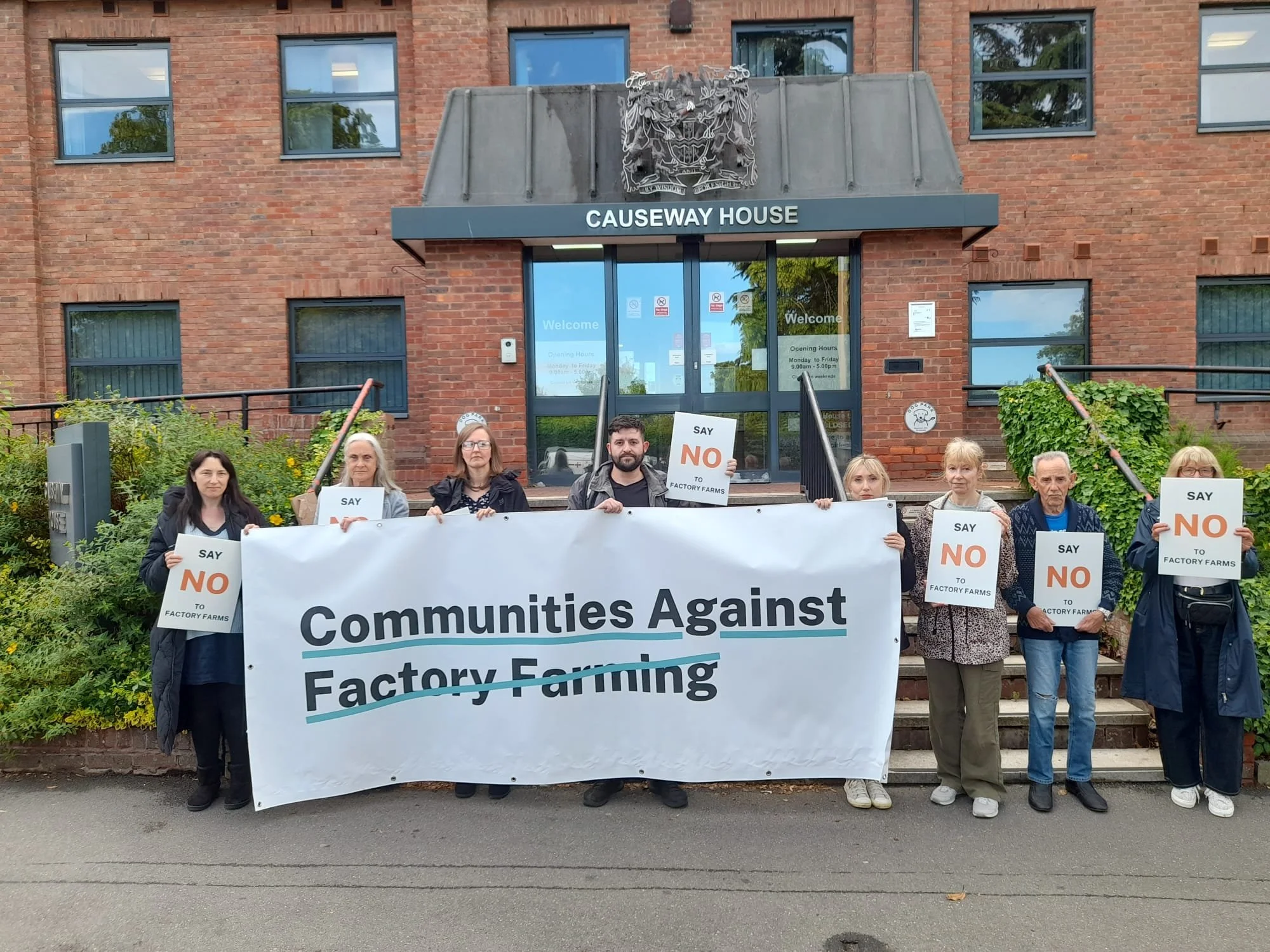
The claim raises concerns about the Council relying on inconsistent information (and bare assurances from the applicant) regarding the scope of the proposed operation, as well as its inadequate consideration of environmental impacts and animal welfare. [1]
The Council assessed the proposal as a replacement building with no increase in bird numbers or intensification of the existing operation.
However, the applicant’s ammonia assessment described replacing a barn housing 5,000 turkeys with a controlled-environment building housing 26,219 broiler chickens. The Council appears to have relied on unsupported assurances from the applicant’s agent that the ammonia assessment’s description was erroneous and that the operation would remain at 5,000 turkeys, without obtaining the promised corrected ammonia assessment or securing that restriction by condition. [2]
Separately, an Environment Agency permit issued shortly before the planning committee meeting authorised a two-house installation with capacity for 109,628 broilers. [3]
Richard Buxton Solicitors are acting for Communities Against Factory Farming (CAFF), a not-for-profit grassroots organisation supporting communities opposing the expansion of factory farming. The challenge concerns Braintree District Council’s decision of 19 June 2026 to grant planning permission for the development.
Maya Pardo, CAFF’s Director, said:
"This case is hugely important for stopping the spread of factory farming, which is so harmful to animals and the environment. In intensive chicken farms, birds are crowded in sheds where they will never see daylight, unable to move freely and bred to grow so fast that their lives are filled with pain. The ammonia and particulate matter released by factory farms has been linked to asthma, cardiovascular disease, lung cancer and dementia, so it is extraordinarily reckless for the council to approve this expansion without understanding the expected impacts for the local community."
CAFF argues that the Council failed to resolve these conflicting descriptions (each of which would likely result in different conclusions on impacts of the development) before granting permission, which also contains no condition limiting bird numbers or species.
A central issue is whether the Council should have required an Environmental Impact Assessment (EIA), or undertaken screening to determine whether one was necessary. CAFF contends that the Council failed to consider properly whether the replacement building formed part of the wider two-house installation which would require EIA. Alternatively, it argues that the replacement building itself required screening under the EIA Regulations. The claim also challenges the absence of assessment of climate and carbon impacts.
CAFF further argues that the Council unlawfully relied on the environmental permitting regime to answer matters requiring its own planning assessment, including operational scale, waste and off-site manure effects. It challenges the failure to obtain corrected technical evidence and further advice or consultation after the applicant’s agent stated that the ammonia assessment’s description was erroneous. Ventilation details and noise, odour and dust assessments were instead left to conditions requiring later approval.
The claim also concerns animal welfare benefits advanced in support of the application. CAFF argues that those claimed benefits (which appear to have weighed in favour of permission in the Council’s view) were neither adequately assessed nor secured by the permission. A further ground challenges the adequacy of the Council’s reasons.
On 9 October 2026, Mr Justice Mould granted permission to proceed on all six grounds. A substantive hearing is likely to occur in early 2027.
Acland Bryant of Garden Court Chambers is instructed as counsel in the case.
ENDS
Word count: 596
Communities Against Factory Farming (CAFF) works with residents across the UK to review planning applications for intensive farms and submit strong, evidence‑based planning objections. The organisation has helped communities block and overturn multiple intensive poultry unit applications when councils overlooked key environmental and animal‑welfare issues.
See high-quality photos here: https://show.pics.io/hubbards-farm-protest
All images in this press release, on our social media and on our website can be used with credit to Communities Against Factory Farming under ‘fair use’ for the purposes of reporting.
For information or further comments, please contact:
Daniel (Press Back Office), press@caff.org.uk, +44 7895 780283
Notes for Editors:
[3] https://consult.environment-agency.gov.uk/psc/cm7-5az-gst-limited-epr-jp3228lq-a001/