
Welton Cliff Farm
OBJECT NOW!
Welton Cliff Farm
Deadline: 6th July 2026
Please submit your objection to this environmental permit application for an intensive chicken breeding farm in Welton, Lincolnshire.
How to Object to the Environmental Permit Application
Copy the objection comments below.
Click the ‘Object Now’ button below.
Scroll down on the Environment Agency page and click ‘Share your views.’
At Question 4, copy-paste the objection below.
Objection comments
I object to application EPR/MP3621LD/A001 for an environmental permit to rear 160,000 broiler breeder chickens in 2 newly proposed and 3 existing sheds. The application is for Annyalla Chicks (UK) Broiler Breeders Limited at Welton Cliff Poultry Farm, Welton, Lincoln, LN2 3PU.
The proposed total number of chickens confined at this site is around 150,000 every year.
The application for Welton Cliff Poultry Farm is currently being treated as a Schedule 2 development not requiring a mandatory Environmental Impact Assessment (EIA), however under the Town and Country Planning (Environmental Impact Assessment) Regulations 2017, poultry installations exceeding 60,000 places for hens are classified as Schedule 1 developments where an EIA is compulsory. An application for 60,000 broiler breeder places therefore necessitates extraordinary scrutiny to ensure that it meets the rigorous regulatory standards required to demonstrate that harm to the environment, people and wildlife will be minimised. The application, as currently amended, fails in several key areas.
Fundamental Inaccuracies in Ammonia Assessment
The application relies on environmental modelling that is technically invalid. The Environment Agency’s "Duly Making" audit identified that the initial ammonia screening was conducted for a capacity of 50,000 pullets, while the actual permit application requests 60,000 broiler breeder (rearing) chickens. The Agency explicitly stated that a 20% increase in bird numbers necessitates a re-run of the ammonia assessment to determine if emissions remain within allowable thresholds. There is no evidence in the revised May 2026 documents that this updated technical assessment has been completed or provided. The operator has also to clarify the animal type, which invalidates the emission calculations used in the original screening. Furthermore, the operator asserts compliance with BAT 31b5 (forced drying of litter using indoor air). However, without a re-run of the ventilation and ammonia modelling for the requested 60,000-bird capacity, this remains a technical assumption rather than a proven fact.
Deficiencies in Manure Management Proposals
The proposed manure management plan fails to provide the "robust" evidence required for a 60,000-bird installation. The operator claims to meet BAT 24 (monitoring total N and P excreted) via calculation. However, because the bird type and numbers are unconfirmed, these calculations are fundamentally flawed and cannot prove that nutrient loads are being minimised in line with Best Available Techniques. The application states that used litter is not stored at the installation and is instead exported to third parties or power stations. However, the Odour Management Plan admits that contingency plans are required if disposal routes are compromised. The application fails to identify a legal, SSAFO-compliant bunded, and covered storage area on-site to handle manure during such interruptions, representing a significant risk of uncontrolled storage or run-off. While manure is exported, the operator must still ensure the receiving land follows the Code of Good Agricultural Practice (COGAP). Given the site’s location in a Nitrate Vulnerable Zone (NVZ), the failure to provide accurate nitrogen excretion data for the full 60,000-bird capacity makes it impossible for the regulator to ensure that exported waste will not cause an environmental breach elsewhere. To compound the problem, the Site Condition Report admits that "no formal assessments have been made of the soils on the site". Without this baseline, the operator may be unable to legally demonstrate at a future date that manure management or chemical storage has not caused land deterioration, which is a requirement for permit compliance and future surrender.
Failure to Assess Cumulative (In-Combination) Effects
The application fails the mandatory legal test under Regulation 63 of the Conservation of Habitats and Species Regulations 2017, which requires an assessment of effects "either alone or in combination with other plans or projects". The Site Condition Report confirms a further permitted poultry site only 680m to the north, operated by the same company. Because the individual ammonia contribution of Welton Cliff is underestimated by 20%, any calculation of how its emissions combine with this or other neighbouring farms to impact the Bardney Limewoods Site of Special Scientific Interest (SSSI) or Wickenby Woods SSSI is technically unsound.
Omission of Local Water Features and Groundwater Risks
The environmental risk assessment is incomplete and fails to account for highly sensitive local receptors. The application’s OS map clearly identifies two "Reservoirs" immediately northwest of the site. These are entirely omitted from the textual descriptions of receptors in the Non-Technical Summary and the Site Condition Report. Regulatory guidance requires a water features survey of all features within 1km of the activity. The failure to assess these reservoirs suggests a lack of due diligence in identifying pathways for potential pollution. The Site Drainage Plan includes an un-lined attenuation pond. The Environment Agency (EA) has required confirmation that this pond will not receive contaminated water from manure handling or washing, a risk that has not been adequately mitigated for a high-capacity 60,000-bird site. The site’s topsoil is "shallow... loamy texture which is freely draining over chalk and limestone," creating a direct, high-risk pathway to the underlying aquifer. This is particularly concerning as the site is in a Nitrate Vulnerable Zone (NVZ) and a Drinking Water Protected Area designated "At Risk" for groundwater, with a status already classified as "poor". Furthermore, the application does not quantify the volume of water that will be required, making long term sustainability impossible to assess.
Failure to Protect People (BAT 13)
The application fails to demonstrate adequate protection for local residents and holidaymakers.
The nearest sensitive receptor (a holiday let) is only 60 metres from the boundary. The operator admits that BAT 13 (ensuring adequate distances from sensitive receptors) is "Not Applied”. Regulatory standards require high-tech mitigation when distance is insufficient. Despite this, the operator only added perimeter "sniff testing" after being prompted by the EA and has not committed to permanent noise or dust abatement measures (e.g., evergreen hedges) unless problems arise after the permit is granted.
Legal EIA Thresholds and Biodiversity Duties
At 60,000 places, this site sits precisely on the legal boundary that would mandate a full Schedule 1 Environmental Impact Assessment (EIA) if it were for hens. Sitting on this threshold requires rigorous scrutiny. Using an ammonia screening based on only 50,000 birds to justify bypassing a full EIA is technically and legally unsound. Under the Environment Act 2021, public authorities have a strengthened duty to "conserve and enhance" biodiversity. This application focuses only on staying within outdated screening limits and fails to propose any meaningful actions to enhance the local environment.
Animal Welfare and Wider Impacts
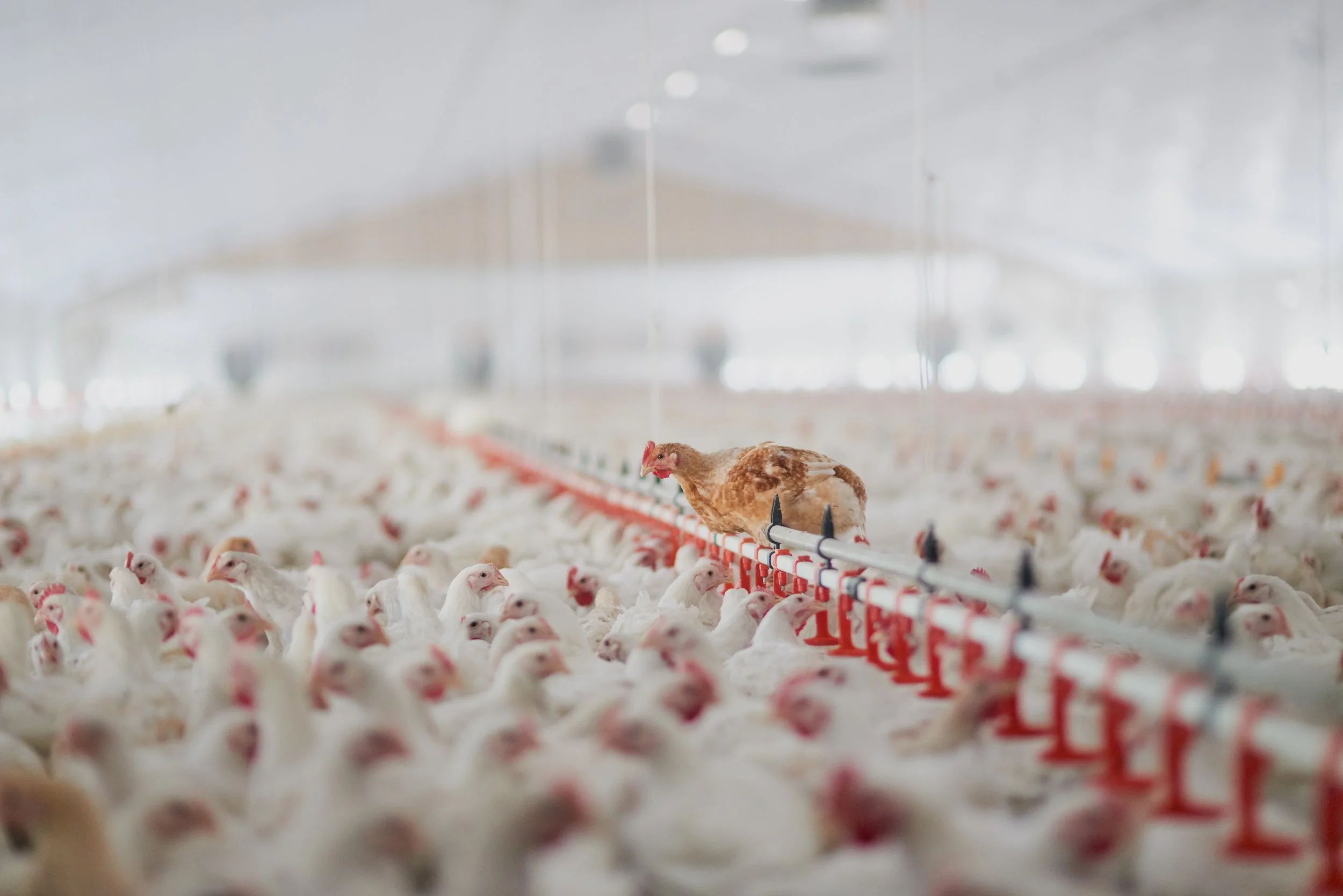
Following R(Animal Equality UK) v North East Lincolnshire Borough Council [2025] EWHC 1331 (Admin), animal welfare is a material consideration. Chickens confined to factory farms suffer horrific cruelty, due to both their fast-growing genetics and cramped, crowded housing. A European Food Safety Authority 2023 report recommended a maximum stocking density of 11kg/m2 to give broiler chickens sufficient space to express their natural behaviours and support their health, but the applicant gives no details about stocking densities or environmental enrichment opportunities. This lacks the transparency required for the public to evaluate the ethical and welfare impacts of the operation. Furthermore, extending or permitting new intensive livestock farming fails to address the growing risks posed by factory farms:
- To national security.
- To food security.
- To public health.
- Environmental risks associated with high-demand soy feed and its link to global deforestation.
- Unsustainable resource wastage caused by feeding plant protein to farmed animals.
- Of zoonotic disease pandemic.
- Of antibiotic resistance.
These are among the most serious issues of our time and should not be ignored.
Conclusion
The permit application for Welton Cliff Poultry Farm is based on fundamentally inaccurate data and contains significant omissions regarding local water features and manure storage. Until the ammonia and ventilation screening is re-run for 60,000 birds, in-combination effects are quantified, and all required fees are paid, the permit must be refused to prevent certain harm to the "At Risk" groundwater supply, local wildlife, and residents.