
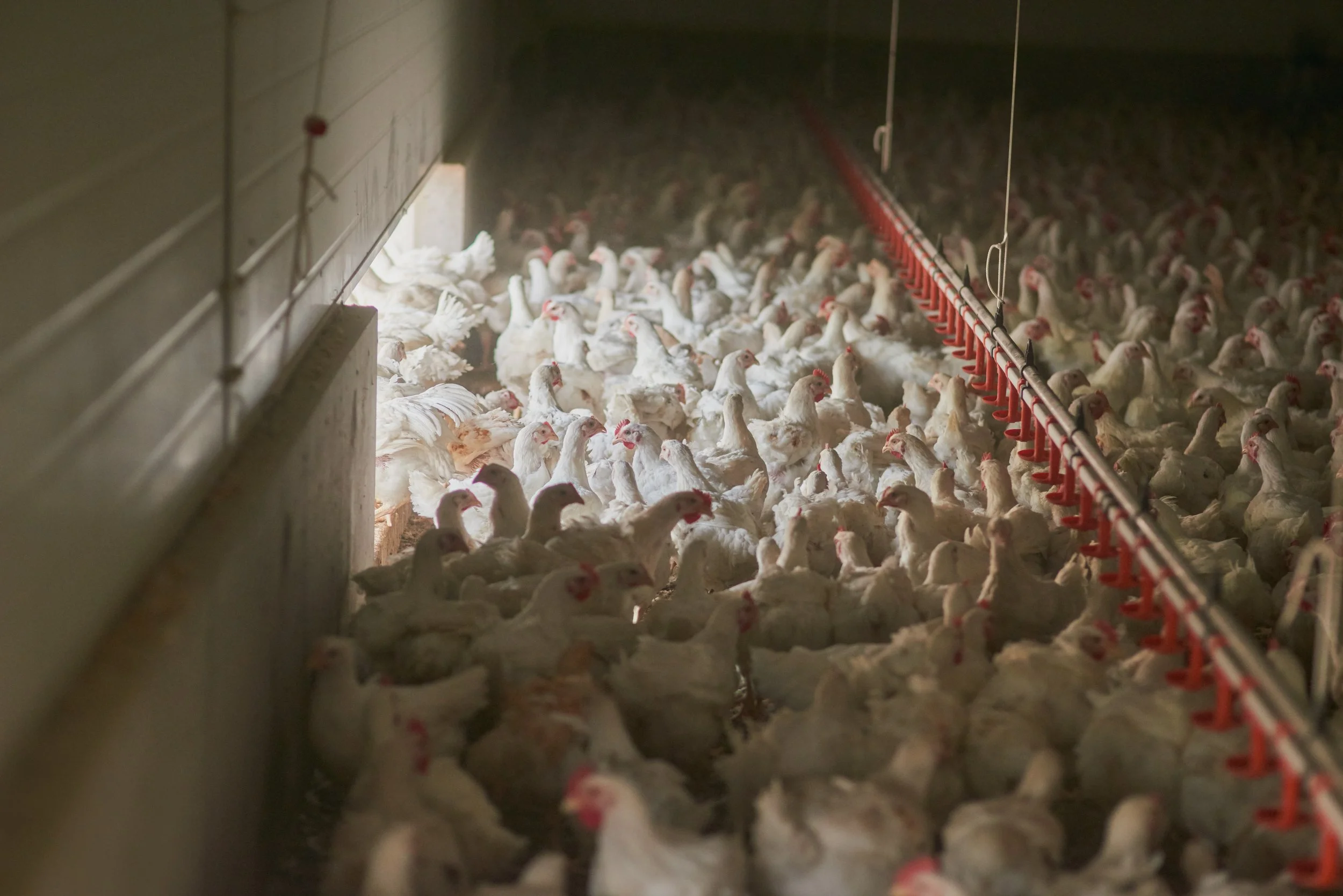
Stack Field Farm
OBJECT NOW!
Stack Field Farm
Deadline: 20th July 2026
Please submit your objection to this environmental permit application for an intensive chicken farm in Nottingham.
How to Object to the Environmental Permit Application
Copy the objection comments below.
Click the ‘Object Now’ button below.
Scroll down on the Environment Agency page and click ‘Share your views.’
At Question 4, copy-paste the objection below.
Objection comments
I object to application EPR/DP3235QW/V003 for an environmental permit to rear 360,000 broilers in 8 poultry houses. The application is for Stack Field Farm, Fosse Way, Cropwell Bishop, Nottinghamshire NG12 2JU.
1. Relevant offences
Question 3 of the application regarding relevant offences has been answered “No”. This is contrary to published information as follows:
https://www.bbc.com/news/articles/clll3r0e33no
These breaches by Moy Park Limited should be disclosed in the application.
2. The permit will lead to significant amounts of slurry, yet questions about slurry in the application are answered as if there were no slurry.
The nontechnical summary states:
“At depletion the litter will be removed from site and sold. The farm will then be pressure washed disinfected, dried out prior to the cycle beginning again”.
The nontechnical summary also states “Dirty water tanks along with sediment traps are emptied by a third party”.
The technical standards state that “Drainage from animal housing and water from cleaning out will be collected in underground storage tanks as shown on the site drainage plan” and “The wash water tanks are built to conform to SSAFO Regulations specifications in SGN EPR6.09“.
The regulations referred to in SGN EPR6.09 are the Water Resources (Control of Pollution) (Silage, Slurry and Agricultural Fuel Oil) (England) Regulations. According to those regulations, slurry is defined as follows.
“slurry” means liquid or semi-liquid matter composed of—
(a) excreta produced by livestock while in a yard or building (including that held in wood chip corrals); or
(b) a mixture wholly or mainly consisting of livestock excreta, livestock bedding, rainwater and washings from a building or yard used by livestock,
of a consistency that allows it to be pumped or discharged by gravity at any stage in the handling process;
Furthermore, SGN EPR6.09 states that “Drainage from animal housing and water from cleaning out is considered to be slurry and should be collected in a tank or lagoon prior to land spreading or disposal”.
3. The site condition report states that the site is located within a nitrate vulnerable zone (NVZ). Storage of manure and slurry in such zones is subject to special requirements.
https://www.gov.uk/guidance/storing-organic-manures-in-nitrate-vulnerable-zones
Yet there is no reference to these requirements or management of them in the application or any of the accompanying documents.
4. Effect of contingency arrangements
While the odour management plan states that “Litter removed from site and sold to third parties” and “At clean out dirty water from houses together with lightly contaminated yard wash is directed to the underground storage tanks, before being removed off site by a third party with any surplus litter”, there is a lack of detail regarding the ultimate destination of this waste.
The technical standards state that "contingency arrangements are in place with surrounding farms to accept the manure in case of an emergency". The applicant should provide a map of receiving land to ensure waste is not simply being moved within the same NVZ or to another NVZ. Given the state of our nation's water bodies, this is crucial to avoid additional water pollution.
5. Incineration
In the document identified as “waste minimisation” the applicant states "Poultry carcasses are, under normal circumstances, collected and stored in sealed containers awaiting regular collection under the fallen stock scheme by a licensed collection agent, or incinerated in a DEFRA approved incinerator”.
If incineration is intended, the atmospheric impact of burning fallen stock from a 360,000-bird population must be included within the emissions and odour data.
6. Biosecurity
In the environmental management system summary, the applicant states: "Site does not have a secure boundary fence".
SGN EPR6.09 states:
“You should have site security measures in place to prevent unauthorised access to the site,
as far as practicable.
The objective of this is to ensure that the site is secure to prevent vandalism, which is a
common cause of pollution incidents. What is appropriate will depend on the risks posed by
the activity itself and the particular location.
To comply you should provide the following:
• security checks or supervision of people entering the site during normal working hours;
• gates that are closed and locked outside normal operating hours to prevent people
walking or driving onto the site;
• fences or hedges around the site perimeter that prevent unauthorised access;
• individual facilities including slurry tank valves and oil tank outlets should be locked, and
buildings should be protected from unauthorised access;
• signs warning people not to enter the site.
The above may not apply if you have a public footpath going through your site”.
There is no public footpath going through the site.
This lack of a secure perimeter is insufficient to prevent unauthorised access to the site, increasing the risk of accidental or intentional contamination of the local environment and watercourses.
7. Other relevant considerations
Based on the nontechnical summary which states that there will be 7.5 cycles per year, the proposed total number of chickens confined for meat production is 2,700,000 every year.
A public authority which has any functions exercisable in relation to England must from time to time consider what action the authority can properly take, consistently with the proper exercise of its functions, to further the general biodiversity objective.
https://www.legislation.gov.uk/ukpga/2021/30/section/102
This applies to the Environment Agency, which is a “public body”.
The Environment Agency states that by 2050 it looks “to nature and nature-based solutions to reduce environmental risks and create more naturally functioning places, catchments and landscapes with ecological corridors, and bio-secure climate-smart agricultural practices the norm”.
For 2026/2027 the Environment Agency’s priorities include “continuing to work with farmers on their environmental performance, through farm inspections and by supporting environmentally friendly farming practices”.
Animal farming at current levels is unsustainable without imports - soy from South America makes up 18% of produced animal feed.
Farming occupies around 70% of the UK land surface. Nature-friendly farming remains essential to both nature recovery and broader environmental goals.
Loss of biodiversity is a national security issue.
The EAT-Lancet Commission found that food is the single strongest lever to optimise human health and environmental sustainability on Earth.
https://eatforum.org/wp-content/uploads/2025/09/EAT-Lancet_Commission_Summary_Report.pdf
Agriculture and rural land use are the main sources of nitrogen and phosphorous pollution.
https://researchbriefings.files.parliament.uk/documents/POST-PN-0755/POST-PN-0755.pdf
The impact of spreading digestate/manure/slurry as fertiliser must be taken into account.
https://www.bailii.org/ew/cases/EWHC/Admin/2025/1497.html
Scope 3 emissions should be taken into account.
https://www.bailii.org/uk/cases/UKSC/2024/20.html
Animal welfare considerations may be taken into account.
https://www.bailii.org/ew/cases/EWHC/Admin/2025/1331.html
The world simply doesn’t need more intensive animal agriculture creating pollution of air, soil and water (locally and nationally), greenhouse gas emissions (internationally), pandemic risks (internationally), loss of biodiversity in the places where the animal feed is grown (internationally), antibiotic resistance (internationally) and of course more suffering for the animals reared in such facilities.
I urge the Environment Agency to reject this application.