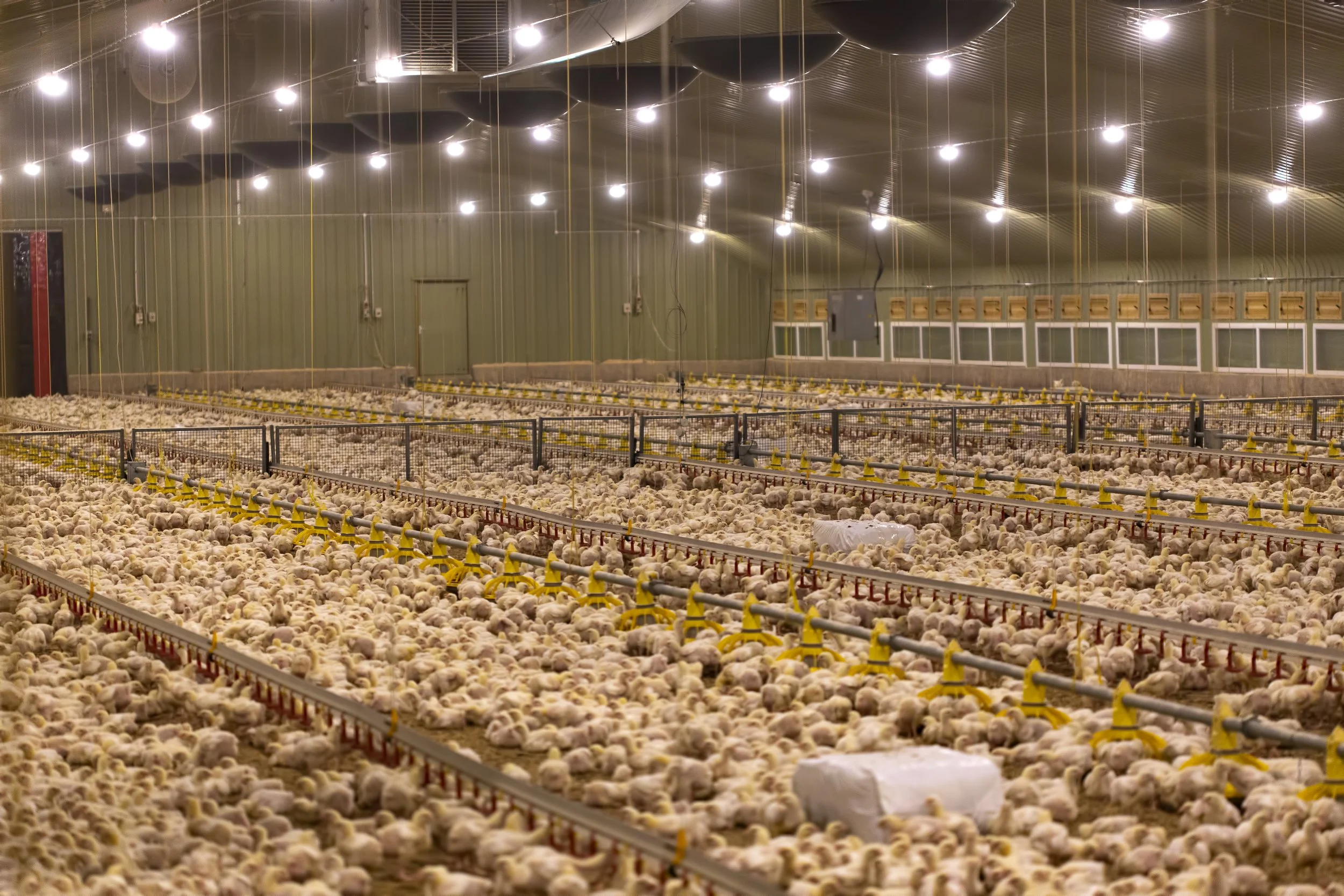
Snetterton Farm
OBJECT NOW!
Snetterton Farm
Deadline: 23rd April 2026
Please submit your objection to this environmental permit application for an intensive poultry unit in Snetterton Heath, Norfolk.
How to Object to the Environmental Permit Application
Copy the objection comments below.
Click the ‘Object Now’ button below.
Scroll down on the Environment Agency page and click ‘Share your views.’
At Question 4, copy-paste the objection below.
Objection comments
I object to application EPR/YP3732YS/V003 for an environmental permit for a change from turkey (97,137 places) to broiler (300,000 places) and improvements to containment at Snetterton Poultry Unit, Chalk Lane, Snetterton Heath, NR16 2JZ.
The proposed intensive poultry unit is for chicken places in excess of 85,000 and therefore requires a full Environmental Impact Assessment (EIA) under Schedule 1, para. 17 of the EIA Regulations 2017. The relevant planning authority cannot grant permission without reviewing the EIA, under section 3 of the EIA Regulations 2017.
The application additionally refers to the installation of approximately 2,700 m² of new concrete to improve dirty water containment associated with the proposed production changes. This constitutes a significant engineering operation and therefore “development” within the meaning of section 55(1) of the Town and Country Planning Act 1990 (as amended), which defines development as including “the carrying out of building, engineering, mining or other operations in, on, over or under land”. No evidence has been provided that planning permission has been granted, or that the works are lawful under permitted development rights. Given the scale, and its potential impacts on drainage, runoff and the wider environment, it is highly likely that planning permission is required. This situation emphasises the reason for the requirement to “twin track”; allowing the permit without planning permission risks enabling the development without a full Environmental Impact Assessment. Accordingly, the determination of this permit should not proceed in the absence of clarity that these major works are lawful in planning terms.
While the applicant has described what is being built (the addition of 2,700 m² of new concrete and diverter valves), the following information needed for a full environmental and ecological assessment has not been provided:
a. Although the farm is near the Norfolk Valley Fens Special Areas of Conservation (SAC) and Swangey Fen Sites of Special Scientific Interest (SSSI), there is no evidence of an assessment of the physical impact of the construction phase - such as noise, dust, or runoff from laying 2,700m² of concrete - on these protected sites.
b. The application identifies the groundwater as "vulnerable" but does not provide a site-specific Source-Pathway-Receptor model or data to prove that the concrete barrier is an adequate solution for the specific ground conditions at Snetterton.
c. Laying a 2,700m² impermeable surface significantly alters drainage. The sources do not include quantitative calculations showing how the attenuation pond was sized to handle this specific increased volume or demonstrating a "No Deterioration" test for the receiving blind soakaway.
d. The applicant has not provided a specific engineered maintenance plan to ensure the concrete remains leak-proof over time to prevent groundwater contamination.
e. The applicant has provided the baseline functional information about what is being built, but not the quantitative evidence or project-specific ecological assessments necessary to confirm that these works will not cause long-term harm to the underlying groundwater or the integrity of the nearby SAC and SSSI.
The ammonia assessment for the Snetterton Poultry Unit is fundamentally insufficient as it inappropriately relies on a mass balance calculation to waive the detailed atmospheric dispersion modelling required when nature conservation sites, such as the Norfolk Valley Fens SAC and Swangey Fen SSSI, fail initial high-level screening:
a. Regulatory guidance explicitly states that detailed modelling is required if a "high-level screening" indicates that nature conservation sites - specifically Special Areas of Conservation (SACs) and Sites of Special Scientific Interest (SSSIs) - might not "screen out". For this application, the high-level screening confirmed that the Norfolk Valley Fens SAC and Swangey Fen SSSI failed to screen out. Standard practice requires modelling when emissions exceed 1% of the critical load for SACs. Instead, the EA accepted a simple subtraction of predicted broiler emissions from estimated turkey emissions to justify a "reduction" without modelling the actual deposition at the habitats.
b. The baseline for the mass balance calculation relies on a "worst case" bespoke emission factor for turkeys (0.138 kg NH3/bird/year), without checking whether this emission factor was actually used in previous assessments for this specific site.
c. Gable end fans were apparently already installed at the site but were not mentioned in the current permit. The EA accepted their inclusion in the variation based on the assumption that they will not significantly change dispersion behaviours as they will only be used "infrequently" for temperature control during “hot” weather. Regulatory guidance requires that all emission points be accurately accounted for in the risk assessment. The lack of a quantitative limit or monitoring requirement for "infrequent" use or “hot” weather means there is no regulatory mechanism to ensure these fans do not become a primary source of poorly dispersed ammonia during warmer seasons. Given the predicted rise in global temperatures, their effects on emission dispersion cannot be assessed on the data provided.
d. There is an assumption of “no change other than species”. The proposed increase in bird numbers (from 97,137 turkeys to 300,000 chickens) represents a substantial intensification to a different species which will alter ventilation, emission profile and timing. It is not a like for like change.
Under standard guidance, an operator must assess ammonia emissions against three specific standards: the ammonia critical level, the nutrient nitrogen critical load, and the acidity critical load. Because the application was "screened out" based on mass balance, it completely lacks a numerical assessment of how much nitrogen will be deposited onto the Norfolk Valley Fens SAC. It relies on a qualitative statement in the Fugitive Emissions Risk Assessment that the risk is "not significant" due to the bird type change, rather than providing the data required to prove compliance with the critical loads for specific habitats. This application cannot rationally be considered without detailed assessment of the effects on important habitats, including:
a. Norfolk Valley Fens SAC
b. Swangey Fen, Attleborough SSSI
c. East Harling Common SSSI
d. Old Buckenham Fen SSSI
e. Kenninghall and Banham Fens with Quidenham Mere SSSI
These delicate habitats are all within 5km of Snetterton Poultry Unit. There are others within 10km.
Ammonia emissions are still high, and the application does not use Air Scrubbers, so it is not using Best Available Techniques. Background concentration levels of ammonia are high across the UK, and there is a need to reduce these. The local background concentration levels of ammonia are high, and the proposal breaches the 1% critical load.
The applicant argues that a transition from turkeys to a much larger number of chickens, combined with management practices described in the SGN EPR6.09 technical standards, effectively mitigates environmental harm compared to the previous turkey operation. This reasoning is flawed because, to prove the benefit, the Agency assumed the lowest possible emission factor (0.138) for the previous turkey operation to create a "worst case" scenario. Because this is an assumed figure rather than a site-specific measurement, the actual environmental "gain" depends entirely on the accuracy of that baseline. While ammonia per bird is lower, the sheer volume of 300,000 chickens requires a massive increase in raw materials and logistics. This includes an annual throughput of approximately 3,038,000 vaccine doses, 168 tonnes of bedding (straw/shavings), and 840 litres of disinfectants. It also fails to account for the global environmental footprint, such as the greenhouse gas emissions from imported feed, the effects of increased meat production on UK food security, or the broader impact of the poultry supply chain on UK national security via global biodiversity loss and ecosystem collapse. Natural England is committed to improving biodiversity, therefore allowing another half century of environmental damage from this farm on the grounds that its emissions will be somewhat reduced from its previous levels is not acceptable.
Recent cases have placed stringent obligations on factory farming developments. Following Finch v Surrey County Council [2024] UKSC 20, a project-specific greenhouse gas assessment calculation is required for EIA; this has not been provided. The assessment should include the emissions from the production of animal feed, slaughter, packaging, transport, and sale, which are indirect and consequential effects that are an inevitable consequence of the permitted activity. This omission prevents compliance with the Environmental Permitting (England and Wales) Regulations 2016.
The case of R (Squire) v Shropshire Council [2019] EWCA Civ 888 confirmed that an environmental statement would be legally deficient if it failed to assess the wider impacts of the storage and spreading of effluent from an intensive poultry rearing facility. The case of NFU v Herefordshire Council [2025] EWHC confirmed that chicken manure is waste, and the LPA does not need to rely on the farming rules for water if they are not working. Manure production and its subsequent off-site spreading are an unavoidable by-product of intensive poultry operations, but the applicant proposes that at the end of each production cycle, all used litter is removed from the houses and exported by a third-party company for spreading on agricultural land or for power generation. The application fails to provide a legally adequate assessment of:
a. nutrient pathways to controlled waters,
b. field-level nutrient loading, and
c. resultant impacts on water quality.
d. The Non Technical Summary confirms that the litter is transported in covered trailers and "sent for energy recovery" thus relying on general compliance with farming rules, and actions by third-party land managers. There is no evidence of:
i. binding land management agreements
ii. enforceable nutrient limits
at receiving sites. Such deferral is unlawful; the Environment Agency must itself be satisfied that pollution will be prevented at the point of decision.
The case of R (Caffyn) v Shropshire Council [2025] EWHC 1497 (Admin) directly considered intensive poultry units, and confirms that the planning authority should assess the cumulative impacts of having multiple intensive agricultural developments in one river catchment before granting permission for another. This site lies within the Buckenham Stream Waterbody whose ecological status is designated only as Moderate, with poor livestock and nutrient management already cited as the major contributors to Reasons Not Achieving Good (RNAG). Under the Water Framework Directive, water bodies must not deteriorate in status. With the water supplies in Norfolk currently under stress, the applicant should provide full assessments of:
a. the total nutrient contributions,
b. the cumulative effect with other intensive poultry units (IPUs) in the Cam and Ouse Management Catchment
c. the volume and source of water required by this installation.
Without this information the Environment Agency cannot rationally conclude that further deterioration or threat to drinking water supply will be avoided.
The application’s environmental assessments are fundamentally unsound due to critical internal contradictions regarding the proximity of sensitive receptors. While the Environmental Risk Assessment (ERA) justifies its "not significant" ratings by repeatedly claiming there are no neighbouring dwellings within 400 metres, the applicant’s own Odour and Noise Management Plans explicitly identify five sensitive receptors within 100 metres, including an industrial estate at 25 metres and a farm manager’s house at 0 metres. This oversight is significant because receptors within 100 metres trigger the mandatory requirement for a dust and bioaerosol management plan, yet the applicant provides only qualitative assertions rather than the quantitative technical modelling necessary to prove that emissions from 300,000 birds will be controlled to an acceptable level. Furthermore, the assessments fail to comply with Environment Agency risk methodology, which dictates that operators must assume human error will occur at least once every 100 operations; instead, the applicant dismisses major risks like dirty water tank overflows and litter spillages as "unlikely" based on simple promises of "careful management". The odour assessment features conflicting monitoring commitments at the boundary - ranging from 30 days into each crop cycle to weekly - and failing to provide a professional impact assessment that accounts for the increased odour "loading" inherent in nearly tripling the site's previous bird capacity, including the massive increase in open-door situations associated with increased number of crop cycles.
Following R(Animal Equality UK) v North East Lincolnshire Borough Council [2025] EWHC 1331 (Admin), animal welfare is a material planning consideration and the public have the right to ask the planning authority to give moral weight to the horrific cruelty experienced by chickens in factory farms due to both their fast-growing genetics and cramped, crowded housing. This installation will be operated in accordance with the Assured Chicken Production Scheme which allows a stocking density of 38 kg/m². This represents approximately the area of an A4 paper per bird, yet a European Food Safety Authority 2023 report recommended a maximum stocking density of 11kg/m2 to give broiler chickens sufficient space to express their natural behaviours and support their health. Chickens are known to have a useful sense of smell and are therefore likely to be as distressed by the noxious odours inside the sheds as the humans at the 5 sensitive receptors identified within 400m. Additionally, chickens are social beings, intended to live in small groups; when forced into large, overcrowded conditions they suffer stress from the breakdown of their natural social order.
Failure to assess the full implications from feed poses a direct threat to UK national security. Increasing demand for soy for feeding farmed animals is a primary driver of deforestation, accelerating the global biodiversity loss that HM Government identifies as a threat to national security, and deepening an unsustainable dependency on imported South American soy, which already constitutes 18% of produced UK animal feed. Such developments exacerbate cascading risks - including geopolitical instability, resource competition, and interstate conflict - whilst also heightening pandemic risk from zoonotic disease through the overcrowding of domestic poultry, highlighting the need for robust pandemic preparedness. Because the UK lacks sufficient land to simultaneously rear livestock at current scales and feed its population, national resilience necessitates a wholesale change in consumer diets toward the predominantly plant-based Planetary Health Diet rather than the expansion of intensive units that lock the nation into fragile international supply chains. Similarly, the UK Climate Change Committee advises a 25% reduction in total meat consumption by 2040 to meet climate and health targets. Therefore granting of permits to produce more meat is in direct opposition to recent scientific and Government reports.
Intensive poultry production represents an inherently inefficient use of grain protein. Of 100g of grain protein fed to chickens, only 34g is converted to edible protein. Since the grain could have been fed directly to humans this represents an environmentally disastrous and unsustainable process which does not support local, national or global food security and sustainability goals. Furthermore, no information is provided regarding the associated environmental impacts of deforestation, soil degradation, air and water pollution caused by pesticides and fertilisers used to increase yields
The application represents a significant intensification of land use with serious consequences to the amenity of local people, public health, the environment, and the animals. Increases in odours, dust, ammonia, pollution, traffic, manure, waste, dirty water, greenhouse gas emissions, and the downstream direct and indirect impacts on people, ancient woodlands, SAC/SSSIs protected sites, the climate, and rivers should all be fully assessed. In addition, the further permitting of activities which are fundamentally misaligned with international, national and local goals and plans intended to protect the climate, biodiversity, food security and public health would be misguided. It is therefore extremely important that no permit is granted without a robust Environmental Impact Assessment.
The Environment Agency should refuse this application.