
Residents Unite to Oppose Intensive Chicken Farm Application in Telford
Shropshire residents came together at a public meeting at Waters Upton Village Hall to stop a factory farm being built in Rowton, Telford. [1]
Attendees expressed their concerns about water abstraction and local biodiversity, among other planning considerations.
If approved, the intensive poultry unit (IPU) would confine 180,000 “broiler” chickens at any one time, which means another 1.35 million birds every year in Shropshire.
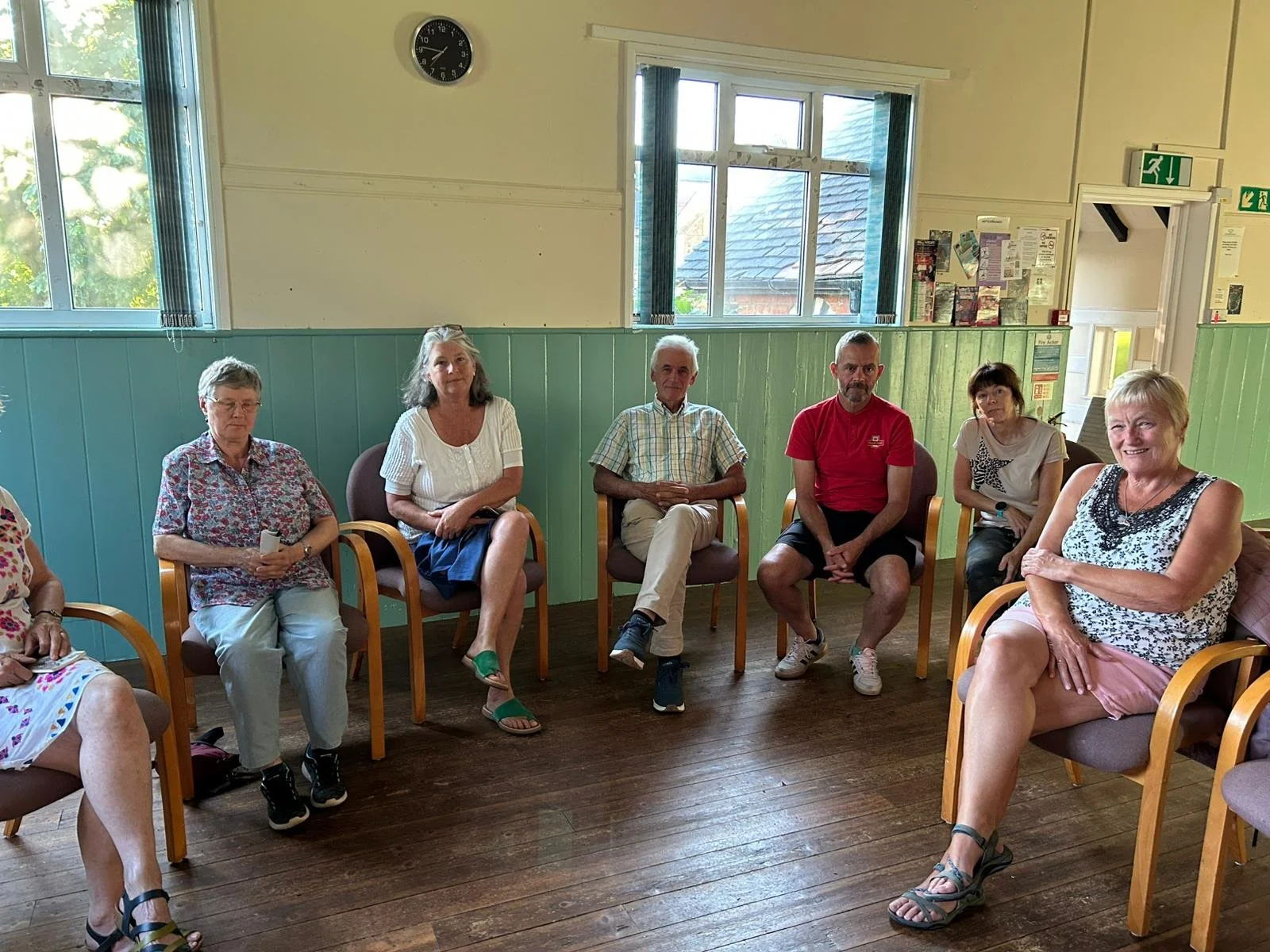
Local residents gathered in Waters Upton Village Hall on 2 July to voice their concerns about a new factory farm proposal in Rowton, Telford.
Rebecca Morris, 64, a Shropshire resident, who attended the meeting, said:
“Shropshire is already the UK’s second most intensively farmed county, and suffers from the air and river pollution that goes with that. I object to this application that will subject chickens to short lives indoors where they will never be able to feel sunlight or grass, and will bring more traffic and pollution to this rural area.”
The application does not provide any information on the estimated water consumption of the poultry unit. Moreover, it also omits whether any infrastructure is required to support the water supply to it.
England is already facing growing water scarcity, and the need to conserve water for future generations is becoming increasingly urgent. The Environment Agency has warned that England may face a daily shortfall of 5 billion litres of water by 2055 unless significant reductions in demand are achieved.
Telford & Wrekin Council has objected to the proposal, as has Ercall Magna Parish Council.
Residents also expressed worries about nature and animal welfare. In particular, many feared for the impact on nearby Sites of Special Scientific Interest (SSSIs) notably Hodnet Heath, Wrekin and Ercall, and Allscott Settling Ponds. Importantly, Allscott Settling Ponds SSSI is currently categorised as ‘unfavourable – declining’, yet the ammonia impact assessment does not make any meaningful assessment of this habitat. There are also three Local Nature Reserves within a 10km radius.
Animal welfare, which can be a material planning consideration, was mentioned as a key concern too. Barnes Farm would use “broiler” chickens bred for rapid growth, often referred to as “Frankenchickens” because of the unnatural speed with which they grow. The use of faster-growing breeds results in painful health problems, such as leg disorders and heart failure, as their bodies develop faster than their bones and organs can cope. Chicks also lack access to natural light, and are unable to spread their wings or dustbathe.
Given the large impact of this development, many suggested the decision should go through the full democratic process of the planning committee, rather than being delegated to a single unelected officer, as is currently planned.
Communities Against Factory Farm (CAFF) is supporting local residents who are opposing the application.
Maya Pardo, Legal Coordinator at Communities Against Factory Farm (CAFF), said:
“Local residents are worried about what this factory farm would mean for their quality of life, the health of local waterways and the birds trapped inside. Chicks raised for meat are bred to grow at an unnaturally fast rate, which causes immense suffering throughout their short lives.
“This application has provoked strong local opposition, and there is an overwhelming environmental argument to prevent the accumulation of more factory farms in Shropshire.”
ENDS
Word Count: 547
About CAFF
Communities Against Factory Farming (CAFF) works closely with residents across the UK to review planning applications for intensive farms and submit strong, evidence‑based planning objections. The organisation has helped communities block and overturn multiple intensive poultry unit applications when councils overlooked key environmental and animal‑welfare issues.
For more information or further comments, please contact:
Daniel (Press Back Office)
press@caff.org.uk
Notes to Editors