
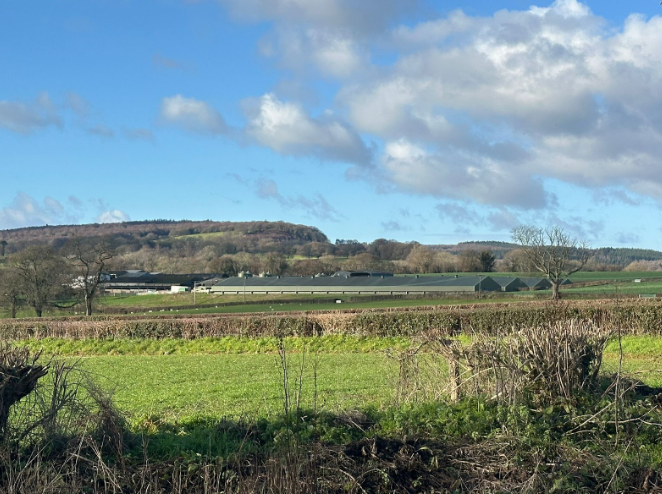
View of the expansive poultry factory farm in rural Shirenewton
Plans have been submitted to expand Coombe Farm, an intensive poultry unit near Shirenewton, Chepstow, to house an additional 240,000 chickens a year which would bring the total to 1.89 million chickens per year. [1]
The proposal has prompted growing concern from local residents, who say the factory farm is already causing significant odour, traffic and pollution issues.
Although the formal consultation period has closed, Monmouthshire County Council is still accepting public comments on the application due to ongoing public interest.
Local residents are actively objecting to the expansion of Coombe Poultry Farm near Shirenewton, Chepstow. Communities Against Factory Farming (CAFF) have been supporting the campaign.
The applicant describes the proposed 30 kg/m² stocking density as “higher welfare”, but local residents say this is misleading, noting that it is close to the legal minimum and far above independent scientific recommendations, such as a report from the European Commission which advises that birds should have three times more space than what this farm will provide.[2] Accordingly, campaigners argue that the proposed stocking density would still leave birds with very limited space, contributing to well‑documented issues such as lameness and footpad dermatitis.
Additionally, ammonia from the sheds can turn into tiny particles (PM2.5) that are linked to cardiovascular and respiratory diseases in humans and other serious health issues. Residents say it is worrying that particulate matter impacts have not been assessed, especially as the nearest homes, including The Cwm, are only around 340 metres away [3].
Last year’s Finch ruling by the Supreme Court made clear that developers must provide a full ‘scope 3’ emissions greenhouse‑gas assessment, disclosing the emissions from feed, slaughter, transport and sale, yet none has been submitted. [4]
Campaigners argue that, with official advice calling for reduced meat consumption and a shift toward more plant‑based diets, permitting further intensive livestock expansion would contradict both Government guidance and the UK’s climate and resilience goals [5].
Imogen, 23, a charity campaigner from Chepstow, said:
“This farm is already having a devastating impact on the local community, with persistent noxious odours, frequent large animal transport vehicles on narrow rural lanes, and serious concerns about soil and water pollution. These risks are especially alarming given the site's close proximity to the River Wye. I am also deeply troubled by the welfare of hundreds of thousands of chickens kept in intensive, unnatural conditions. It is difficult to see how further expansion at the expense of local residents, wildlife and animal welfare can be justified.”
The proposed expansion also threatens nearby ancient woodland, an irreplaceable habitat the Woodland Trust describes as “our richest, most biodiverse land habitat” and one that cannot be recreated once damaged [6]. Allowing a development of this scale so close to such sensitive habitat would contradict national conservation priorities and undermine efforts to protect the UK’s most vulnerable natural assets.
Communities Against Factory Farming have successfully helped locals block new factory farms or expansions of existing ones in Shropshire, Norfolk and Devon [7] [8] [9].
ENDS
Word Count: 526
About CAFF
Communities Against Factory Farming (CAFF) works closely with residents across the UK to review planning applications for intensive farms and submit strong, evidence‑based planning objections. The organisation has helped communities block and overturn multiple intensive poultry unit applications when councils overlooked key environmental and animal‑welfare issues.
Link to high res image here: https://show.pics.io/coombe-farm
All images and videos in this file, on our social media, and on our website can be used with credit to Communities Against Factory Farming under ‘fair use’ for the purposes of reporting.
For more information or further comments, please contact:
Emma (Press Back Office) +44 1225 29 6691
press@caff.org.uk
Notes to Editors
[1] Planning Application: DM/2024/02046
[2] EFSA Panel on Animal Health and Welfare (AHAW), Welfare of Broilers, 2023
https://efsa.onlinelibrary.wiley.com/doi/10.2903/j.efsa.2023.7788
(The European Food Safety Authority (EFSA) has advised that stocking densities should be reduced to around 11 kg/m² to allow broiler chickens adequate space for natural behaviours and to protect their health.)
[3] Ammonia Emissions from Poultry Production, Natural Resources Wales (NRW), 2021
[4] Finch v Surrey County Council, 2024 https://www.bailii.org/uk/cases/UKSC/2024/20.html
[5] The Sixth Carbon Budget, The UK’s Path to Net Zero, The Climate Change Committee, 2020 https://www.theccc.org.uk/publication/sixth-carbon-budget/?utm_source=copilot.com
(The CCC explicitly recommends a 20-50% reduction in meat and dairy consumption, with a central scenario of 25% less meat by 2030, as necessary for meeting legally binding carbon budgets.)
[6] Planners’ Manual for Ancient Woodlands, The Woodland Trust, 2019 https://www.woodlandtrust.org.uk/media/51656/planners-manual-for-ancient-woodland.pdf?utm_source=copilot.com
[7] Shropshire braces for “chicken megafarm” battle as residents and industry clash, Shropshire Live, 2025 https://www.shropshirelive.com/news/2025/06/15/shropshire-braces-for-chicken-megafarm-battle-as-residents-and-industry-clash/
[8] Planning permission for 310,000-chicken intensive poultry unit in Norfolk to be quashed, Landmark Chambers, 2025
[9] Reversal of Devon Intensive Dairy Farm Planning Permission Celebrated by Locals