
Locals Oppose Intensive Poultry Unit Application in Northumberland Village
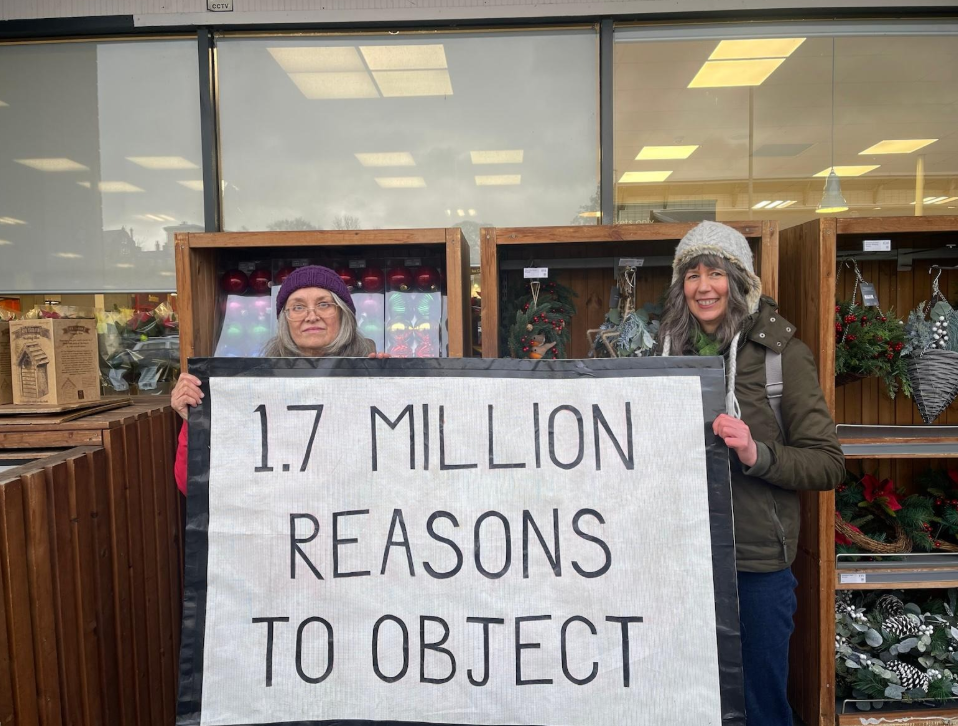
Well House Farm, in Colwell, has applied for planning permission to build four intensive poultry unit sheds for 220,000 broiler chickens total per cycle - around 1.7 million chickens every single year. [1]
Many comments have been submitted objecting to the plans with concerns over animal welfare, environmental pollution, resident amenity, and public health. [2]
There have been over 100 objections so far, with the deadline for public comments being Wednesday 10th December.
The local MP for Hexham, Joe Morris, has submitted a formal representation, outlining strong reasons for refusal. [3]
Locals have been out campaigning in Hexham against plans for new intensive chicken sheds at Well House Farm in Colwell, with residents raising awareness by leafleting door-to-door as well as outside a local supermarket. Communities Against Factory Farming (CAFF) have been supporting the campaign during the consultation period ahead of a decision from the planning committee. Objections to the scheme have also been submitted by campaign groups Compassion in World Farming and Sustain.
Locals are increasingly concerned about not just animal welfare, pollution and impacts on property values, but also bird flu. The strain of bird flu currently circulating in the UK ‘could be the worst yet’ according to experts. [4] In the UK since the start of October there have been 59 outbreaks of bird flu among captive birds and 5,901 reports totalling 153,468 deaths among wild birds, according to the Animal and Plant Health Agency (APHA). [5]
CAFF has recently helped locals overturn planning permission for two poultry houses at Willoughbridge Lodge Farm, on the Staffordshire-Shropshire border, after a legal challenge claiming there were deficiencies in the council's assessment of environmental impacts and animal welfare concerns. [6] There is hope from locals that a similar approach can be taken in this case, should the council approve the plans.
Rachel Mellor, 57, a Sales Assistant from the nearby village of Cambo, said:
“If this proposed factory farm is allowed to go ahead, it will cause irreparable and severe harm to the lives and the health of the men, women and children who call Colwell and the surrounding areas home. It will have a detrimental and dreadful effect on the environment and wildlife, as well as our wonderful Hallington Reservoirs Wildlife Site which is just down the road from the proposed location. Local businesses will suffer and property values will be affected. Residents and wildlife must be protected from the well documented and serious harms of intensive chicken farming. Bird flu outbreaks are in the news all the time now and we’re seeing wild birds being killed from it too. We live in a beautiful part of the countryside and we don't want four giant chicken sheds anywhere near our families and homes.”
Jo Lazarus, Volunteer Coordinator for CAFF, said:
“Locals are rightly horrified at the thought of thousands of birds suffering in terrible conditions just down the road from them. With a planned 38 day cycle, each of these birds would be crammed into crowded sheds, denied the chance to live naturally, and slaughtered at just a few weeks old. Intensive chicken sheds cause a serious nuisance to local residents trying to enjoy a rural life, they increase air pollution, they create a serious risk of water pollution, and they hamper national targets on reducing the carbon emissions from our food. Northumberland County Council absolutely must reject this horrific application for four giant chicken sheds.”
Joe Morris, MP for Hexham, said in his letter to the council:
“There is concern that the proposed development would generate substantial ammonia emissions, odour, and a serious risk of water pollution from manure, wash-down water and surface runoff containing nitrates, phosphates, veterinary medicines and other pollutants. It has been shared with me that the site lies within the catchment of the Colwell Burn, which ultimately feeds into Hallington Reservoir and the River Tyne. Pollution from this unit therefore poses a direct threat to drinking water quality, to protected wildfowl populations at Hallington Reservoir, and to wider aquatic ecosystems and wildlife throughout the Tyne catchment.”
ENDS
Word Count: 671
All images and videos in this file, on our social media, and on our website can be used with credit to Communities Against Factory Farming under ‘fair use’ for the purposes of reporting.
For more information or further comments, please contact:
Emma (Press Back Office) +44 1225 29 6691
Notes To Editors
[1] Well House Farm, Planning Application 25/03717/FULES
[3] https://drive.google.com/file/d/10ZWF2AmOMMn4UZwLk_1dj8fveis1xCNA/view?usp=drive_link
[4] https://www.bbc.co.uk/news/articles/cp85r67kn8xo
[5] Captive: https://www.gov.uk/government/news/bird-flu-avian-influenza-latest-situation-in-england
Wild:
https://experience.arcgis.com/experience/062722fea8b24285b46fa6fc02b9fb51/page/Page/