Porters Farm
OBJECT NOW!
Porters Farm
Deadline: 27th April 2026
Please submit your objection to this environmental permit application for an intensive poultry unit in Spalding, Lincolnshire.
How to Object to the Environmental Permit Application
Copy the objection comments below.
Click the ‘Object Now’ button below.
Scroll down on the Environment Agency page and click ‘Share your views.’
At Question 4, copy-paste the objection below.
Objection comments
I object to application EPR/BP3429MJ/A001 for an environmental permit to rear 360,000 broilers on a new greenfield site, in 8 poultry houses with LPG heating. The application is for Aura Associates Limited at: Porters Farm, Littleworth Drove, Deeping St Nicholas, Spalding, Lincolnshire, PE11 3DG.
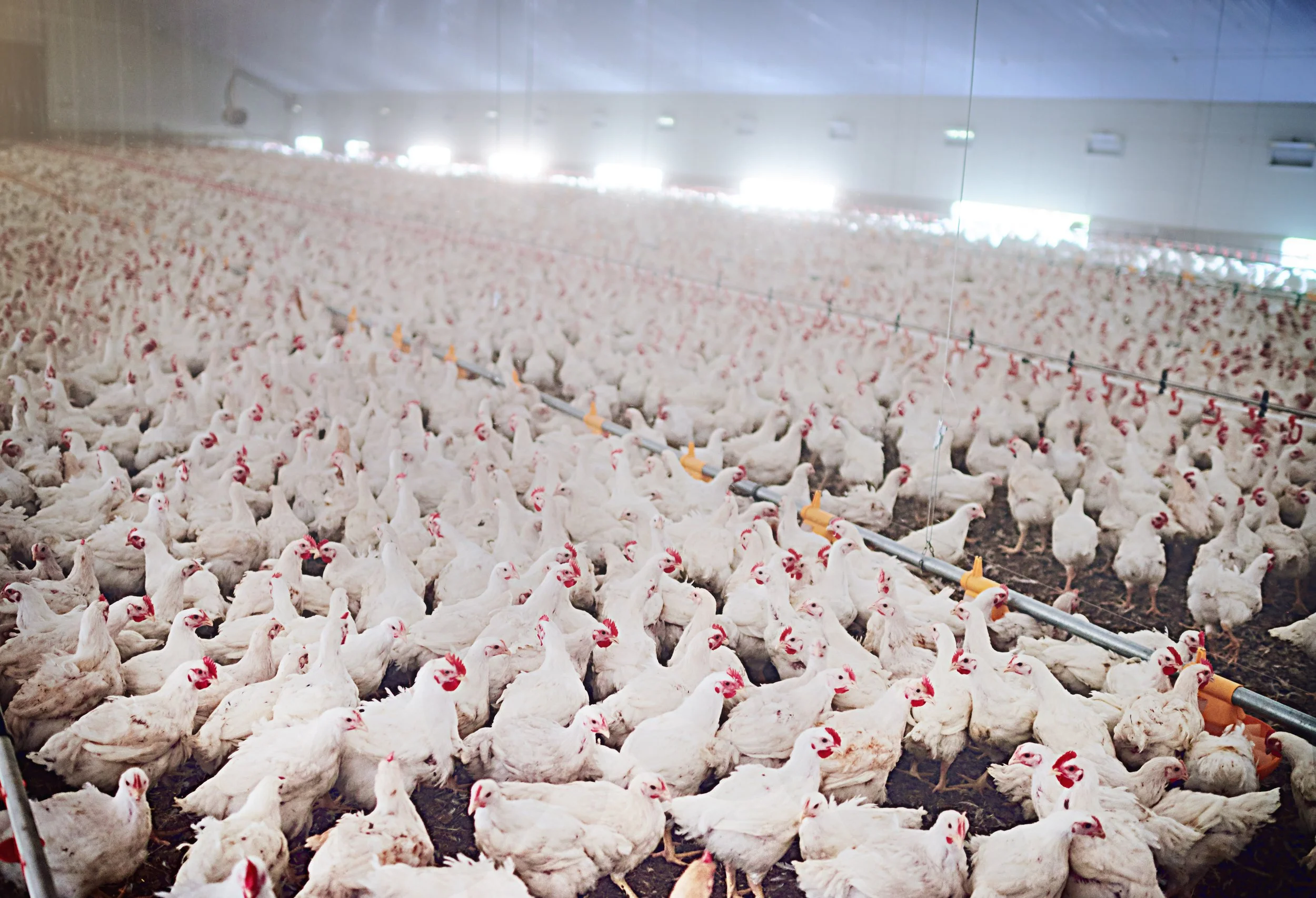
The proposed total number of chickens confined for meat production is in excess of 2.5 million every year.
The proposed intensive poultry unit is for chicken places in excess of 85,000 and therefore requires a full Environmental Impact Assessment (EIA) under Schedule 1, para. 17 of the EIA Regulations 2017. The relevant planning authority cannot grant permission without reviewing the EIA, under section 3 of the EIA Regulations 2017.
The application is for 8 sheds, each measuring 80x360ft with a total floor area of 21,404.8m2 plus an unspecified area of concrete hardstanding. This represents a substantial intensification of land use and the applicant should be required to obtain planning permission before the Environment Agency (EA) grants a permit. This situation emphasises the reason for the requirement to “twin track”; allowing the permit without planning permission risks enabling the development without a full Environmental Impact Assessment. I urge the EA not to grant a permit before the application has planning permission.
The robustness of the decision to screen out ammonia emissions is undermined by factual inaccuracies. The Grid Reference (GR) used for the assessment, dated January 20th 2026, was 520282, 315758, whereas the Site Condition Report and Non Technical Summary list the GR as 520365, 315794. The screening was also based on chicken numbers of 410,000, which the Applicant formally requested to amend to 360,000 on March 25th 2026. While the reduction in chicken numbers might be expected to reduce emissions, the technical basis of the assessment is inconsistent with the final permit application. Additionally, the screening results are strictly dependent on the specific housing system described: fan-ventilated, fully littered floors with roof vents at least 5.5 metres high and a fan efflux velocity of 11 m/s. The Environment Agency explicitly states that if the applicant alters the housing type or ventilation system, a new screening assessment is required; since there is no planning permission in place, there is no guarantee of adherence to this design and no consideration given for the predicted effects of climate change on fan usage.
Furthermore, the applicant’s ammonia assessment is unsound as it relies on an assumption of consistently optimal “Best Available Techniques” (BAT) management that is not realistically achievable at a scale of 360,000 birds. The Welfare of Farmed Animals (England) Regulations 2007 (Schedule 5A, 11 (1)) and the Defra Code of Practice for the Welfare of Meat Chickens require the health and walking gait of all birds to be inspected at least twice daily, necessitating access to every bird. At this scale and stocking density, such inspections cannot reliably detect all instances of wet or capped litter arising from diarrhoea or drinker leakage, creating a foreseeable “inspection gap”. These conditions are well established drivers of elevated and highly variable ammonia emissions, often exceeding the steady-state factors used in screening models. Given the proximity of Cross Drain SSSI and Cowbit Wash SSSI within the 5 km screening distance, the Environment Agency must apply the Conservation of Habitats and Species Regulations 2017 and the Precautionary Principle. Under the Habitats Regulations, as interpreted by binding retained EU case law including People Over Wind v Coillte Teoranta (C-323/17), mitigation measures cannot be relied upon at the screening stage, and permission may only be granted where there is no reasonable scientific doubt as to the absence of adverse effects on site integrity. Such reliance on modelling that assumes idealised management and does not account for operational variability and human error is not legally or scientifically robust, and risks underestimating emissions and consequent harm to protected sites.
Recent cases have placed stringent obligations on factory farming developments. Following Finch v Surrey County Council [2024] UKSC 20, a project-specific greenhouse gas assessment calculation is required for EIA; this has not been provided. The assessment should include the emissions from the production of animal feed, slaughter, packaging, transport, and sale, which are indirect and consequential effects that are an inevitable consequence of the permitted activity. This omission prevents compliance with the Environmental Permitting (England and Wales) Regulations 2016.
The case of R (Squire) v Shropshire Council [2019] EWCA Civ 888 confirmed that an environmental statement would be legally deficient if it failed to assess the wider impacts of the storage and spreading of effluent from an intensive poultry rearing facility. The case of NFU v Herefordshire Council [2025] EWHC confirmed that chicken manure is waste, and the local planning authority (LPA) does not need to rely on the farming rules for water if they are not working. Manure production and its subsequent off-site spreading are an unavoidable by-product of intensive poultry operations, but the applicant fails to provide a cohesive management plan for spent litter, manure and foul water, or legally adequate assessment of:
a. nutrient pathways to controlled waters,
b. field-level nutrient loading, and
c. resultant impacts on water quality.
While the application claims that "litter is not stored at the installation", it identifies "temporary field heaps" as a risk management measure and for emergency disposal. Although these may be outside the installation boundary, their management is part of the overall environmental impact of the operation, yet the plans for these heaps are vague (e.g., heaps will be covered only "if flies become an issue"). Litter is to be spread on operator-controlled land. The area is a Nitrate Vulnerable Zone where spreading of manure is only allowed at specific times; this installation will produce vast quantities of manure at the end of each production cycle, 7-7.5 times per year, and the applicant should be required to demonstrate BAT appropriate storage facilities for manure awaiting spreading. The application lacks a robust Manure Management Plan.
The case of R (Caffyn) v Shropshire Council [2025] EWHC 1497 (Admin) directly considered intensive poultry units, and confirms that the planning authority should assess the cumulative impacts of having multiple intensive agricultural developments in one river catchment before granting permission for another. The formal "Waste Management Plan" provided in the application is significantly incomplete in its focus on comparatively minor waste streams such as paper and glass, while completely ignoring the primary waste streams of spent litter and dirty water. By excluding the primary pollutants of a 360,000-bird installation from the main waste plan, the applicant fails to provide a cohesive strategy for the handling and disposal of the most significant environmental risks. It is unclear whether the waste water tanks yet exist, owing to conflicting use of past and present tense in the application documents. This discrepancy makes it impossible for the regulator to verify if the structures currently in place (if they exist) meet SSAFO Regulations or if they are yet to be built to those standards. Without capacity data, it is impossible to determine if the tanks can safely handle the high volume of water generated during the pressure-washing of eight large poultry houses 7 to 7.5 times per year. The site is within a Surface Nitrate Vulnerable Zone. Despite this, the plan to spread wash water on "operator-controlled land" lacks a detailed nutrient management assessment to ensure that such spreading does not lead to leaching or runoff into watercourses such as South Drove Drain (2 km away) or add nutrients to the River Welland which is already sensitive to eutrophication from agricultural pollutants. In the event of a "Foul Water" containment failure, the Emergency Plan instructs staff to "Stop washing" and "Use Farm equipment for wastewater removal". The plan is flawed because it fails to define how the staff will know that a failure is occurring, what this equipment is, where the emergency-recovered water would be safely disposed of, or how the operator would manage a major breach that exceeds the capacity of standard farm machinery. The contingency plan for waste water removal relies on informal "agreements with neighbouring farms". There is no evidence of formal contracts or verification that these farms have the requisite permits or capacity to accept large volumes of foul water during an emergency. Furthermore, the Site Condition Report explicitly states that there will be no monitoring of soil or water quality at the installation, making it impossible to detect the effects of pollution until irreversible environmental damage has occurred. The installation will be using water for both consumption and cleaning out of the 8 sheds, 7- 7.5 times per year, but neither source nor the volume are specified. Under the Water Framework Directive, water bodies must not deteriorate in status, therefore the applicant should provide full assessments of:
a. the total nutrient contributions,
b. the cumulative effect with other IPUs in the Anglian River Basin,
c. the volume and source of water required by this installation.
Without this information the Environment Agency cannot rationally conclude that further deterioration or threat to drinking water supply will be avoided.
Following R(Animal Equality UK) v North East Lincolnshire Borough Council [2025] EWHC 1331 (Admin), animal welfare is a material planning consideration and the public have the right to ask the planning authority to give moral weight to the horrific cruelty experienced by chickens in factory farms due to both their fast-growing genetics and cramped, crowded housing. A European Food Safety Authority 2023 report recommended a maximum stocking density of 11kg/m2 to give broiler chickens sufficient space to express their natural behaviours and support their health, but the applicant gives no details about stocking densities or environmental enrichment. The total shed floor area (21,404.8 m²) and chicken numbers (360,000) suggest that each bird is likely to have less space than the area of an A4 sheet of paper, which is clearly inadequate. Chickens are known to have a useful sense of smell and therefore likely to be distressed by the noxious odours inside the sheds. Additionally, chickens are social beings, intended to live in small groups; when forced into large, overcrowded conditions they suffer stress from the breakdown of their natural social order.
Failure to assess the full implications from feed poses a direct threat to UK national security. Increasing demand for soy for feeding farmed animals is a primary driver of deforestation, accelerating the global biodiversity loss that HM Government identifies as a threat to national security, and deepening an unsustainable dependency on imported South American soy, which already constitutes 18% of produced UK animal feed. Such developments exacerbate cascading risks - including geopolitical instability, resource competition, and interstate conflict - whilst also heightening pandemic risk from zoonotic disease through the overcrowding of domestic poultry, highlighting the need for robust pandemic preparedness. Because the UK lacks sufficient land to simultaneously rear livestock at current scales and feed its population, national resilience necessitates a wholesale change in consumer diets toward the predominantly plant-based Planetary Health Diet rather than the expansion of intensive units that lock the nation into fragile international supply chains. Similarly, the UK Climate Change Committee advises a 25% reduction in total meat consumption by 2040 to meet climate and health targets. Therefore granting of permits to produce more meat is in direct opposition to recent scientific and Government reports.
Intensive poultry production represents an inherently inefficient use of grain protein. Of 100g of grain protein fed to chickens, only 34g is converted to edible protein. Since the grain could have been fed directly to humans, this represents an environmentally disastrous and unsustainable process which does not support local, national or global food security and sustainability goals. Furthermore, no information is provided regarding the associated environmental impacts of deforestation, soil degradation, air and water pollution caused by pesticides and fertilisers used to increase yields.
The application represents a significant intensification of land use with serious consequences to the amenity of people, public health, the environment, and the animals. Increases in odours, dust, ammonia, pollution, traffic, manure, waste, dirty water, greenhouse gas emissions, and the downstream direct and indirect impacts on people, ancient woodlands, SAC/SSSIs protected sites, the climate, and rivers should all be fully assessed. In addition, the further permitting of activities which are fundamentally misaligned with international, national and local goals and plans intended to protect the climate, biodiversity, food security and public health would be misguided. It is therefore extremely important that no permit is granted prior to planning permission being granted, as the EIA will only be reviewed during the planning consultation process.
The Environment Agency should refuse this application.