
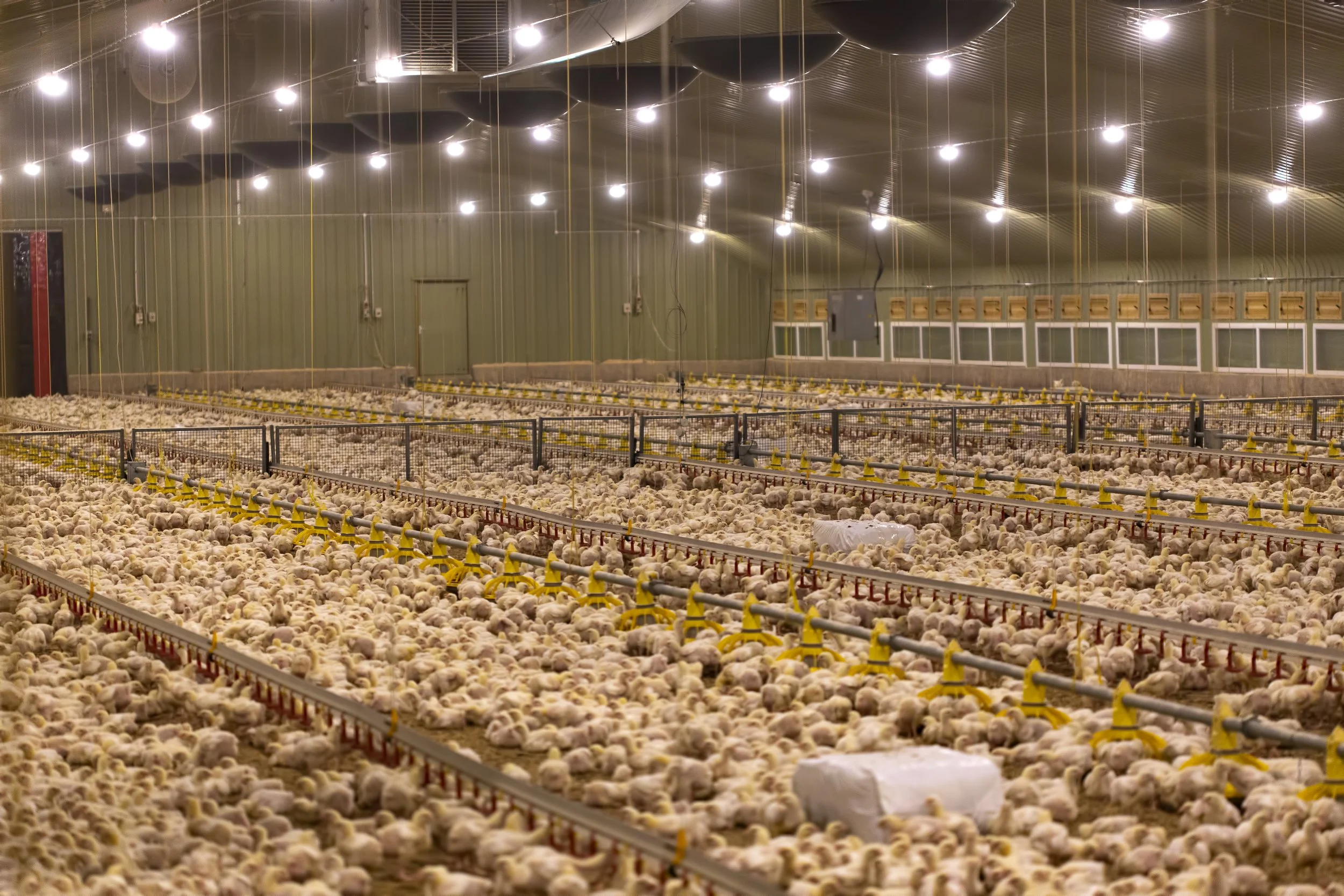
Kirby Wold Farm
OBJECT NOW!
Kirby Wold Farm
Deadline: 2nd July 2026
Please submit your objection to this environmental permit application for an intensive poultry unit in Malton, Yorkshire.
How to Object to the Environmental Permit Application
Copy the objection comments below.
Click the ‘Object Now’ button below.
Scroll down on the Environment Agency page and click ‘Share your views.’
At Question 4, copy-paste the objection below.
Objection comments
I object to application EPR/GP3924ML/A001 for an environmental permit to rear 140,000 broilers in 2 newly proposed and 2 existing sheds. The application is for Kirby Wold Farming Ltd. at: Kirby Wold Poultry Farm, Fen Lane, Malton, YO17 8DG.
The proposed total number of chickens confined for meat production at this site is around 1 million every year.
Procedural Failure: Absence of Mandatory Environmental Statement (ES)
The application lacks the evidence required to confirm that a mandatory Environmental Impact Assessment (EIA) was performed. Under the Town and Country Planning (EIA) Regulations, intensive poultry installations with more than 85,000 places for broilers are classified as Schedule 1 developments, for which a full EIA and the submission of an Environmental Statement (ES) are compulsory. The application contains irreconcilable contradictions regarding its EIA status: the applicant ticked "Yes" to having conducted an EIA in Part B3.5, yet the Application Checklist identifies the EIA requirement as "N/A". Crucially, the North Yorkshire Council Notice of Decision fails to list an "Environmental Statement" under Condition 02. Without an ES, the regulator and the public lack the comprehensive data required by law to evaluate the project’s total impact on biodiversity, water quality, and human health.
Factual Inaccuracy: Proximity of Sensitive Receptors
The application relies on a flawed environmental baseline. The Odour Assessment, Noise and Vibration Assessment, and Fugitive Emissions Assessment all state there are "no neighbouring dwelling houses within 400m". This is demonstrably untrue. The applicant’s own Dust Management Plan (DMP) explicitly identifies Kirby Wold House at 22m and Kirby Wold Cottage at 47m. Because the core risk assessments deny the existence of these residents, the regulator cannot verify the applicant's claim that nuisance risks are "not significant" for people living just 22 metres from the installation. Consequently, the application fails to meet the legal standard of proving that "harm to the environment, people and wildlife will be minimised".
Environmental Protection Failure: water and waste water
The drainage strategy ignores the site’s extreme hydrological sensitivity. The farm is situated in a High Groundwater Vulnerability Zone, a Surface Nitrate Vulnerable Zone (NVZ), and a drinking water safeguard zone directly above a Principal Bedrock Aquifer (Welton Chalk Formation). Despite these designations, the application contains:
- Reliance on Manual Intervention: The management of "dirty water" relies on the manual placement of "diverter bungs" during wash-down to prevent contaminated water from entering the "clean" drainage system. This system is highly susceptible to human error. Any failure would direct concentrated wash-down water into French drains and an unlined attenuation pond, providing a direct pathway for pollutants to leach into the Principal Aquifer. This violates the "no deterioration" principle of the Water Framework Directive and fails to satisfy Best Available Techniques (BAT) 18, which requires leak-proof facilities and impermeable bases (such as clay or plastic lining) for containment systems.
- Unverified Tank Integrity: While the Technical Standards claim underground dirty water tanks are "built to conform to SSAFO Regulations," the application provides no technical drawings, capacity calculations, or material specifications to prove their integrity or leak-proof status as required by BAT 18.
- Explicit Refusal to Monitor: The applicant’s statement that “no monitoring will be undertaken” at the installation regarding water quality violates regulatory requirements for "requisite surveillance" to protect strategic potable water resources.
- No detail regarding source or quantity of water required by the unit. Without significant changes to water usage, this area is predicted to be short of potable water by 2055. Permitting unquantified use would therefore not be in the public interest.
Failure to Assess Risks to Protected Sites (SSSIs)
The application's ammonia screening is legally and technically deficient. There are three Sites of Special Scientific Interest (SSSIs) within 5 km of the installation: Nine Spring Dale SSSI, Ladymills SSSI, and Stone Dirt and Nova Slacks SSSI. These are not mentioned in the documentation.
- Failure of Cumulative Assessment: Regulatory guidance mandates that if a farm’s individual contribution to nitrogen deposition at an SSSI is between 20% and 50%, the Environment Agency must check the combined emissions from all local permitted farms. The application "screens out" ammonia emissions as "not significant" based on a non-transparent pre-application report, without providing evidence that cumulative risks to these sites were considered.
- Contradictory Receptor Data: The validity of the ammonia screening is further undermined by identifying "no neighbouring dwelling houses within 400m" in the Fugitive Emissions Assessment, while the DMP acknowledges residents just 22m away who will be subjected to these emissions.
Operational Contradictions: Manure and Waste Management
The application presents conflicting accounts of manure handling. The Technical Standards and Site Condition Report claim “litter is not stored at the installation”. However, the Fugitive Emissions Assessment and Emergency Plan provide management protocols for “temporary field heaps” and “field storage”. By claiming "no storage," the applicant avoids providing the detailed mapping and capacity calculations required under SSAFO Regulations. Additionally, the Waste Management Plan fails to quantify the substantial volume of manure that will be produced annually.
Additional Omissions of Mandatory Information
- Missing Management Plans: Written Odour and Noise Management Plans are mandatory for sites with receptors within 400m. The provided "Odour Assessment" and "Noise and Vibration" evaluations are simple risk assessments and do not contain the monitoring protocols, response procedures, or elimination programmes required for formal plans under BAT 11 and 12.
- Biomass Boiler Emissions: The proposed 1.15MWth straw-fired boiler exceeds the 0.5MWth threshold; no project-specific air emissions assessment for NO2 or particulates was provided.
- Greenhouse Gas (GHG) Assessment: Following Finch v Surrey County Council [2024] UKSC 20, a project-specific GHG assessment is required for the EIA; this has been omitted.
- Housing and Drainage Review: The applicant failed to provide the mandatory BAT review for the two existing poultry houses.
Animal Welfare and Wider Impacts
Following R(Animal Equality UK) v North East Lincolnshire Borough Council [2025] EWHC 1331 (Admin), animal welfare is a material consideration. Chickens confined to factory farms suffer horrific cruelty, due to both their fast-growing genetics and cramped, crowded housing. A European Food Safety Authority 2023 report recommended a maximum stocking density of 11kg/m2 to give broiler chickens sufficient space to express their natural behaviours and support their health, but the applicant gives no details about stocking densities or environmental enrichment opportunities. This lacks the transparency required for the public to evaluate the ethical and welfare impacts of the operation. Furthermore, extending or permitting new intensive livestock farming fails to address the growing risks posed by factory farms:
- To national security.
- To food security.
- To public health.
- Environmental risks associated with high-demand soy feed and its link to global deforestation.
- Unsustainable resource wastage caused by feeding plant protein to farmed animals.
- Of zoonotic disease pandemic.
- Of antibiotic resistance.
Conclusion
Due to the factual inaccuracies regarding receptors, inappropriate drainage in a strategic safeguard zone, internal contradictions regarding waste, and the omission of mandatory assessments, the applicant has not provided the "robust proof" required to ensure environmental harm is minimised. I urge the Environment Agency to refuse this permit application.