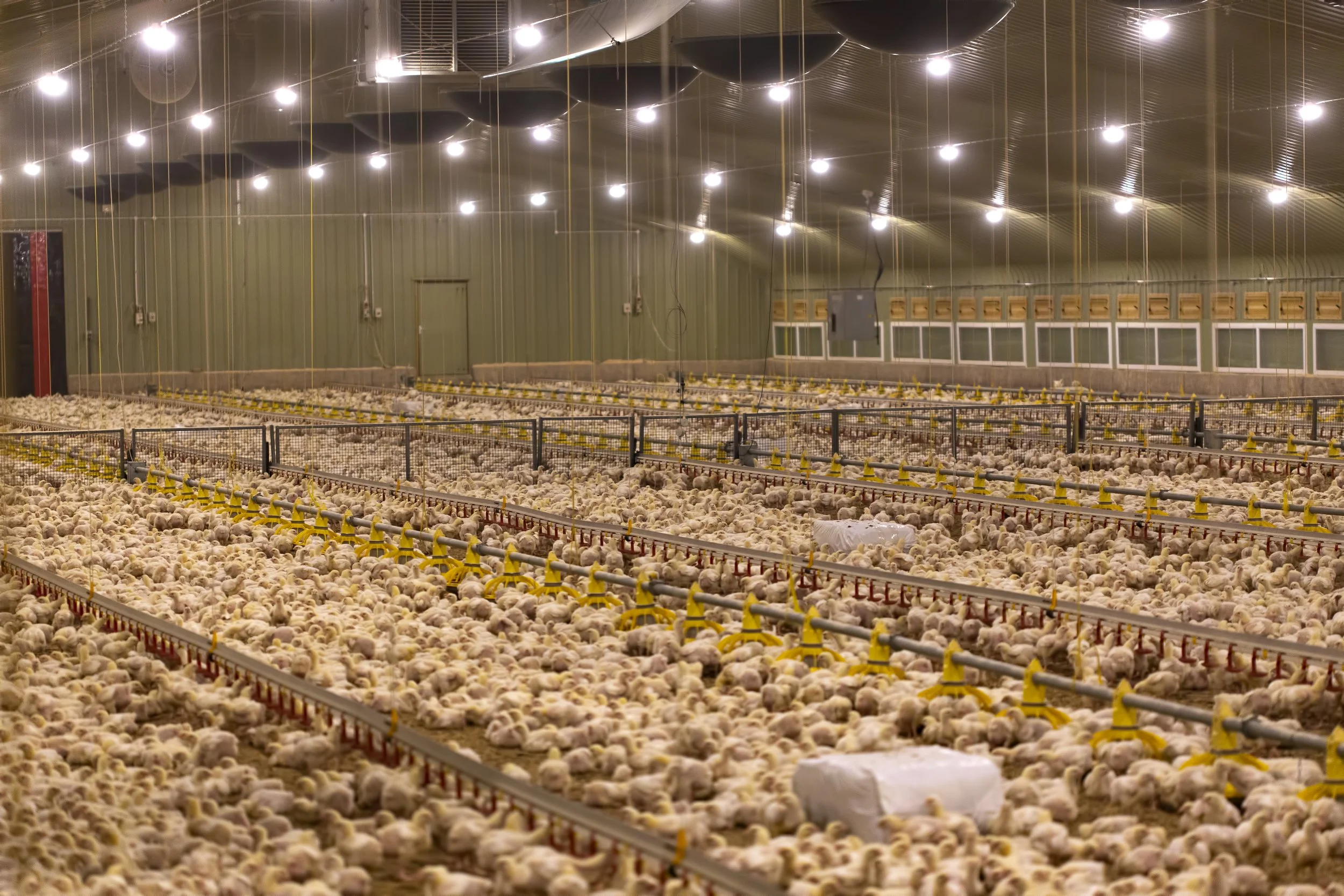
Beech Farm
OBJECT NOW!
Beech Farm
Deadline: 3rd April 2026
Please submit your objection to this Intensive Poultry Unit environmental permit application.
How to Object to the Environmental Permit Application
Copy the objection comments below.
Click the ‘Object Now’ button below.
Scroll down on the Environment Agency page and click ‘Share your views.’
At Question 4, copy-paste the objection below.
Objection comments
Regarding Application Number: EPR/SP3430JR/V004 for a permit for 3 additional poultry houses and an increase of 138,710 bird places to a total of 314,710 places plus increasing the installation boundary to enclose more land (totalling 3.82ha) at Beech Farm, Rectory Lane, Norwich, NR16 1QU.
I urge the Environment Agency (EA) not to grant this permit based on the following grounds.
i. Absence of a mandatory Environmental Impact Assessment (EIA):
Because the proposed installation would increase capacity to 314,710 bird places, it exceeds the 85,000 broiler threshold and therefore falls within Sch 1, para 17 of the Town and Country Planning (Environmental Impact Assessment) Regulations 2017 (“EIA Regulations 2017”), meaning that a full Environmental Impact Assessment is mandatory. The applicant’s H1 Environmental Risk Assessment does not remove the need for an EIA, as an EIA is mandatory in law, and also because the H1 assesses only pollution risks for permitting purposes and does not evaluate the broader environmental effects required under EIA Regulations 2017. The EA therefore should not grant a permit until a comprehensive assessment of the environmental impact has been completed and reviewed by the relevant planning authority.
ii. Material change of use and substantial variation:
This application falls under either definition of a development in s55 Town and Country Planning Act 1990, as it is “the carrying out of building” 3 new poultry houses, or can be argued to constitute a material change of use with a nearly 80% increase in bird places to a total of 314,710, and an increased installation boundary of 3.82ha. Environmental permits and planning permission should be “twin‑tracked,” to ensure all environmental and planning considerations are aligned, and to prevent permits being granted before planning consent.
iii. Residential amenity and health:
The applicant identifies 57 sensitive receptors to noise within 400m, of which 52 are dwellings. Most critically, the dwelling at Hircocks Farm (an offsite dwelling adjacent to the boundary for a farmworker in control of the installation) is a sensitive receptor to dust and bioaerosols at 0m from the installation boundary. Also, Rectory Farm, both with a residential dwelling and an agricultural premises, is located approximately 175m and 230m south of the site, respectively. The applicant's H1 assessment identifies a "moderate significance" (++) risk for dust, bio-aerosols, noise, and odour, acknowledging a "moderate potential to cause annoyance". Under the FIDOR assessment (Frequency, Intensity, Duration, Offensiveness, and Receptor sensitivity), the combined effect of dust and ammonia odour, particularly during peak operations like crop thinning and cleaning out, represents a greater cumulative nuisance than each pollutant considered in isolation. The impact on the health and amenity of these residents must be rigorously investigated, and it has not been adequately mitigated by the provided management plans.
The applicant fails to consider night time conditions: The NMP explicitly states that gable end fans, which are used for additional cooling when birds are hot or during heatwaves, may be “running fans continually day & night”. The NMP also admits that to meet factory requirements, destocking (which involves forklifts and HGVs) can “often start before 07.00 at nighttime”. Destocking is identified as involving forklift trucks (FLTs), which produce engine noise and impact noise from moving transport modules. The H1 assessment identifies noise from these activities as a "Moderate Significance (++)" risk.
Mitigation measures are insufficient when there are many sensitive receptors nearby. The NMP explicitly states that noise from automatic feeding equipment is "unlikely to be perceived offsite" because "much screening effect of buildings provides a barrier". Yet, this shielding assumption is particularly risky for Beech Farm because one sensitive receptor (Hircocks Farm) is located 0 metres from the installation boundary. In such extreme proximity, any "uncertainty" in the shielding calculations or a failure of the sheds to act as a perfect barrier would immediately result in an "adverse impact" on the resident.
Furthermore, ammonia emissions are indirectly responsible for effects on human health, increasing mortality and morbidity throughout the UK. This is because ammonia contributes to the creation of secondary inorganic aerosol, such as ammonium nitrate and ammonium sulphate, which is a contributor to particulate matter (PM). It has been estimated that a global halving of agricultural emissions could reduce the mortality attributed to PM2.5 by ~250,000 globally and by 52,000 across Europe. The applicant's H1 assessment acknowledges that ammonia emissions from this site will have long-term adverse effects on air quality and human health, yet no project-specific quantitative assessment of this impact has been provided.
iv. Impact on designated habitats:
The installation is within 5km of four Sites of Special Scientific Interest (SSSI): Lower Wood Ashwellthorpe, Forncett Meadows, Aslacton Parish Land, and New Buckenham Common. Three of which, Lower Wood Ashwellthorpe, Aslacton Parish Land, and New Buckenham Common, are classed as “unfavourable recovering”. The site is also within 2km of Burwell Wood Ancient Woodland.
Intensive poultry units are major sources of ammonia and nitrogen deposition. The applicant’s H1 risk assessment admits that ammonia emissions cause nutrient enrichment of soils and acidification, which can lead to irreversible changes in these sensitive ecosystems. Nutrient nitrogen deposition can cause ecological impacts in the form of soil eutrophication, excess nitrogen promotes nitrogen tolerant plant species, increasing rates of succession and altering the natural species make-up of the habitat. Tree nutrition and growth can also be impacted by eutrophication, which could lead to changes in resistance to living and non-living stress factors. Hence, it is submitted that the applicant’s mitigating measures are insufficient.
v. Ammonia:
Natural England guidance states that if a proposal contributes 1% or more of the Critical Level or Load, further assessment is required. Given that the UK’s lower bounds for Critical Levels and Loads are already widely exceeded, adding further ammonia to ecosystems already suffering from "hyper-eutrophication" and acidification directly conflicts with conservation objectives.
The applicant relies on pre-application advice from September 2025 stating that detailed modelling was not required. However, the scale of this intensification demands rigorous tracking of the passage of ammonia through the atmosphere to the ground.
Ammonia is an odorous gas. Since the EA normally does not review off site odour assessments, a full EIA is necessary to ensure odours will not be unacceptable to residents. Odours from intensive farms often lead to widespread complaints from residents. They can also lead to costly nuisance disputes with neighbours. Odour is capable of amounting to a nuisance under Section 79(1)(d) of the Environmental Protection Act 1990.
vi. Impact on species:
This area is rich in biodiversity. The Bern Convention and the Habitats Directive require that public bodies use the precautionary principle in considering new developments and to protect legally protected species of wildlife. According to the National Biodiversity Atlas, there are 3405 species in total, of which including 159 species of wild birds, within a 5km radius of the Applicant’s proposed site.
Exceeding the critical load for acid deposition can lead to low soil pH and high aluminium availability, which could cause the habitat to become unsuitable for species. Species reliant on supporting habitats within designations can also be directly affected, for example bird species and invertebrates. Therefore, it would be a conflict with the EA’s duties under the Habitat Regulations 2017 and Wildlife and Countryside Act 1981 to allow an activity which would cause damage or hinder the sites from achieving their objectives. Hence, a full EIA is necessary to consider broader impacts.
vii. Water quality and river catchment vulnerability:
The site is bisected by the River Tiffey and River Tas catchments (tributaries of the River Yare). These waterbodies recently held "Poor" and "Moderate" ecological statuses and “Fail” chemical status tests due to priority hazardous substances (chemicals identified under WFD as posing significant risks to the environment or human health because of their toxicity, persistence, or ability to bioaccumulate). Following R (Caffyn) v Shropshire Council, the EA must assess the cumulative impacts of further intensification within these already failing catchments before granting further intensifications.
The site is located within a Nitrate Vulnerable Zone and a Source Protection Zone 3 (Total Catchment). It sits above a Secondary superficial aquifer with medium groundwater vulnerability and a Principal bedrock aquifer. Intensification here increases the risk of nitrate leaching and surface runoff into catchments that are already failing chemical status targets.
viii. Water sustainability:
The application fails to specify the source or volume of water required for 314,710 birds and the associated 7.6 annual washout cycles of 10 massive sheds. Especially since the quantitative groundwater status is poor for the site’s surrounding area, the EA should investigate whether this expansion poses a risk to local water supplies during drought periods.
ix. Greenhouse gas assessment and downstream impacts:
Following Finch v Surrey County Council [2024] UKSC 20, a project-specific greenhouse gas assessment for the full animal supply chain is required, including emissions from animal feed, transport, and slaughter, specifically imported soy, which is a primary driver of global deforestation and identified by the government as a threat to national security. Finch also established that environmental impacts may occur far from the source and must be fully assessed for EIA. No such assessment has been provided for by the applicant.
Following R (Squire) v Shropshire Council [2019] EWCA Civ 888, an assessment is legally deficient if it fails to evaluate the wider impacts of spreading effluent. NFU v Herefordshire Council [2025] EWHC 536 (Admin) confirmed that chicken manure is waste. This application proposes exporting used litter offsite for land-spreading or power generation, yet it lacks a rigorous assessment of the downstream impacts of this waste.
x. Resource inefficiency and climate targets:
Intensive poultry production is a massively wasteful and inefficient use of resources; of 100g of grain protein fed to chickens, only 34g is converted to edible protein. The grain protein used to feed these 310,000 birds could be more sustainably used for direct human consumption. Granting this permit contradicts the UK Climate Change Committee’s advice to reduce meat consumption by 25% by 2040 to meet health, food security and climate targets.
xi. Zoonotic disease and animal welfare:
Large commercial operations amplify zoonotic disease risks, including Highly Pathogenic Avian Influenza (HPAI). Bird flu risk on IPUs is high. RSPB have noted, “The most recent series of bird flu outbreaks is the largest ever in the UK and worldwide, having killed tens of thousands of birds in the UK alone,” with it being a growing concern here in the UK. Norfolk is a hot spot for bird flu, with 14 cases confirmed in Norfolk since the end of October 2025. Scientists say the risk of the next pandemic from bird flu is rising.
Furthermore, in The Humane League v Secretary of State for Environment, Food and Rural Affairs [2024] EWCA Civ 1560, the Court of Appeal confirmed the legal effect of paragraph 29 of Schedule 1 to the Welfare of Farmed Animals (England) Regulations 2007: “The keeping of animals for farming purposes is prohibited unless it can reasonably be expected, on the basis of their genotype or phenotype, that they can be kept without any detrimental effect on their health and welfare”. This is a mandatory legal precondition to keeping broilers in England. Such assessment is not provided, and crowding 314,710 birds into 10 sheds causes significant stress and prevents natural behaviours.
The lack of enrichment suppresses natural behaviours such as foraging, perching, exploration, and dust-bathing, leading to chronic boredom, frustration, and increased incidence of harmful behaviours like feather-pecking and cannibalism. Depriving birds of behavioural opportunities also contributes to reduced activity levels, poorer leg health, and greater susceptibility to stress, compounding the physical and psychological detriment inherent in intensive conditions.
Conclusion
Given the absence of a full EIA, and the significant consequences to local amenity, public health, the environment, and animal welfare, the Environment Agency should refuse this application.